
Climate-resilient Mowing Mixtures
Why?
Due to climate change, livestock farmers are increasingly confronted with warmer and especially drier summers. Grassland is inherently climate-robust due to its long growing season and thus large compensatory capacity. However, there is still room for improvement when it comes to grass mixtures intended for mowing. These are traditionally composed mainly of English ryegrass. This has shallow roots and requires many nutrients (including nitrogen) and water. If irrigation is not possible, climate-robust mowing mixtures are an interesting alternative, especially on drought-sensitive (sandy) soils.
What
How
Cost
Benefits
Attention
Description & visualization of technique
Farmers can choose to use more complex grass mixtures. Other grass species such as tall fescue, cocksfoot or festulolium root deeper or are better adapted to drought or very wet conditions, legumes extract additional nitrogen from the air and red clover or alfalfa also have a deep taproot. And then there are the herbs, which also often root deeper or more extensively and are therefore drought-tolerant and through their active compounds have a positive effect on, among other things, animal health.
Furthermore, the government supports this with a premium for multi-annual eco-cultivation of grass-herbs. For this, the sown species (at least 2 grasses, 2 clovers and 2 herbs) must be visibly present in the field during inspection.
Productive grass-herb mixtures are new and require specific management. There is little experience and knowledge on how to manage productive grass-herbs under mowing conditions so that the sown species can reach their potential. The question arises whether productive grass-herb mixtures or climate-robust grass-clover mixtures (with alternative grass species) yield more feed value compared to conventional English ryegrass with clover.
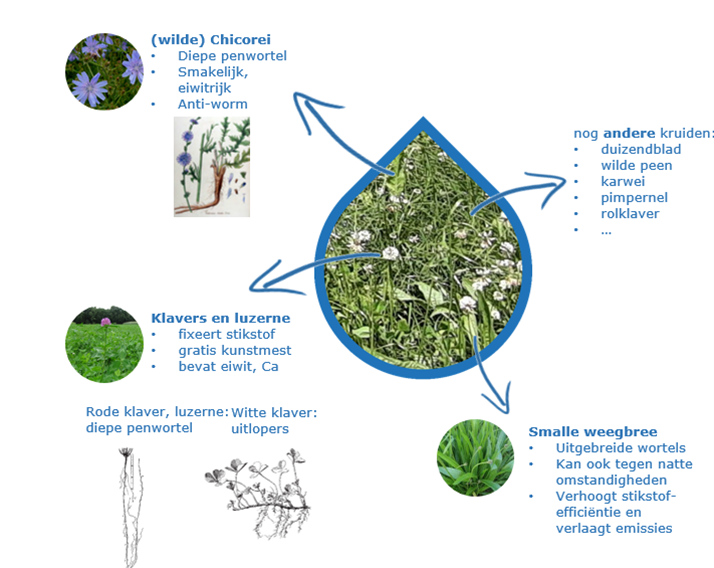
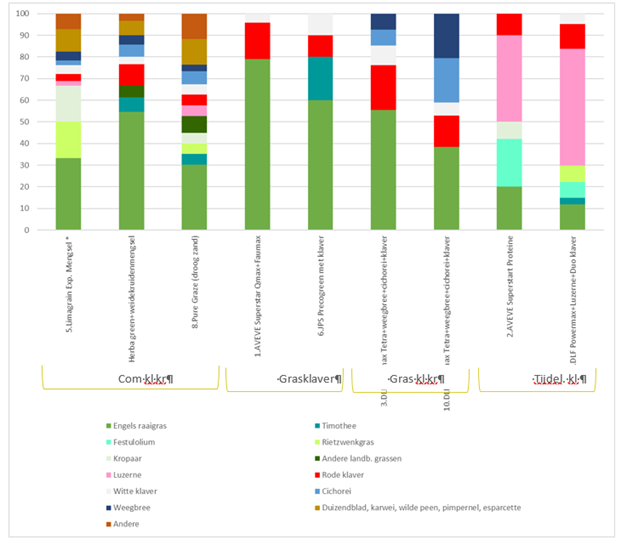
Hooibeekhoeve followed a trial with 10 different climate-robust mowing mixtures from sowing in 2020. Two of them were mixtures of English ryegrass or English ryegrass with timothy and white and red clover as reference, in two mixtures we added narrow-leaved plantain and chicory in addition to English ryegrass with clover. Three mixtures were complex mixtures of grasses, grass-clover and multiple herb species and 3 mixtures contained no herbs but did contain drought-tolerant grasses and legumes. Yield, feed value and species composition were monitored.
Through dissemination of these results, farmers can learn about the potential of alternative grass-legume mixtures or productive grass-herb mixtures. The mixtures are classified into 4 groups for this purpose.
Construction (materials, technical sheet / cross-sections)
Sowing:
- sowing depth: shallow <1 cm, avoid segregation
- seed mixture 40 kg/ha: 25-30 grasses, 7 kg clovers, 3 kg other herbs or legumes (e.g. 1kg narrow-leaved plantain, 1kg chicory, 1kg other herbs)
- timely Sep to mid Oct
- apply false seedbed (not in too dry conditions)
- flat pressed seedbed
- sow possibly under cover crop summer barley e.g. against wind erosion or weeds
Field selection:
- no too high N-mineralization for example after plowed grassland
- added value comes most into its own on drought-sensitive field
- suitable for mowing fields at distance from the farm: less intensive mowing management (fewer cuts)
- field with limited weed pressure
- pH sufficiently high (cf. grass-clover)
Landscape integration
The diversity of the different species will have a positive effect on soil life and soil biodiversity. Whether there is also above-ground benefit in terms of biodiversity through, for example, pollination will probably depend on the presence and flowering time and duration determined by the mowing time. Research is currently ongoing on this.
Due to the extensive root system and somewhat less intensive management, productive grass-herbs certainly offer potential for carbon farming. Research must determine to what extent and under what management grass-herbs contribute to carbon sequestration in the soil.
Maintenance
Fertilization and mowing management
- general: follow the guidelines for grass-clover
- fertilizing: base organic manure, largely in spring (except 1st year before 1st cut), limited supplementation with artificial fertilizer (first year) depending on clover (and herbs) proportion
tip: farmyard manure in winter - mowing: first cuts not too heavy, summer cuts: do not mow too quickly, root reserves: limit tedding in strongly drying weather to avoid leaf loss
Indicative prices for construction and other costs
Just as with grass-clover compared to grass, adding herbs often means an increase in seed cost. Given that a temporary mowing pasture lasts about 4 years, this barely affects the cost price per ha per year. Rule of thumb for grassland is: never save on the quality of grass seed, but on the quantity. After all, if you sow too thickly, the herbs do not get a chance to develop.
Furthermore, the subsidy for multi-annual protein cultivation of grass-herbs compensates for this additional cost. However, pay attention to the conditions, as this cannot be claimed on permanent grassland.
Ecological benefits
Productive grass-herbs or complex grass mixtures with legumes should not be agriculturally inferior to English ryegrass with clover. They require adapted management comparable to grass-clover where the yield and feed value at the first cut will mainly come from the grass and in the summer cuts the added value in terms of climate robustness of the other species becomes apparent.
If the proportion of herbs and the proportion of grass-herbs in the ration is sufficiently high, one may expect a positive effect on the composition of minerals and trace elements, e.g. Selenium. Improvement of animal production results or savings on mineral supplements can then be expected. Other medicinal characteristics of the herbs will probably be weakened by ensiling together or the ensiling process (in contrast to grazing).
Relevant legislation, permits
Take a look at this document from the Agency for Agriculture and Fisheries: Cultivation of multi-annual environmental, biodiversity-friendly and/or climate-resistant crops (Eco-crops)
Sources for information & guidance
Take a look at this document from the Agency for Agriculture and Fisheries: Cultivation of multi-annual environmental, biodiversity-friendly and/or climate-resistant crops (Eco-crops)
Our partners






