
Collection and Reuse of Initial Drainage Water from Substrate Cultivation
Why?
Drain water from greenhouse crops often has an imbalance of nutrients or a higher EC value (Electrical Conductivity) than desired to reuse for a new fertigation.
Combining this drain water with fresh water lowers the EC value and makes it possible to reuse this water in the greenhouse. As a result, drain water cannot be reused directly and requires storage to ensure that no drain water leaves this cyclic process. One solution is to invest in new drain silos to provide additional storage for drain water. The dimensioning of the silos should cover the first three to five months of cultivation with its storage capacity. This capacity also insures that maintenance procedures of the filtration can take place if need be.
Sources
Note removing sludge from drain (age) silos VLIF support for productive investments in water management Manure Decree, 2025 ; Chapter III Measures of Annex II and Annex III of the Nitrates Directive ;Section II The capacity of storage tanks ; Article 9 § 2. Water portal, 2025 Water Portal, 2014, Brochure growing without drainage in greenhouse horticultureWhat
How
Cost
Benefits
Attention
Description & visualization of technique
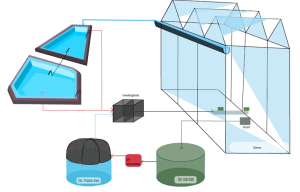
The installation of the additional silos will ensure that sufficient storage is available to reuse all the drain water that is being produced. In the past, it was possible that at times the storage would overflow if we would not intervene, by disposing of some of the drain water. The extra storage silos then allow the grower to be more flexible with drain recovery at the beginning of the season. With this extra storage capacity, periods of high drain water production can be covered without adjusting the reuse settings. This extra storage capacity will result in extra water savings because all this water will be reused. As a result, less rainwater or groundwater will be used to provide water for the crops. At the end of the season, the fertigation can be almost completely sustained with drain water reuse.
Construction (materials, technical sheet / cross-sections)
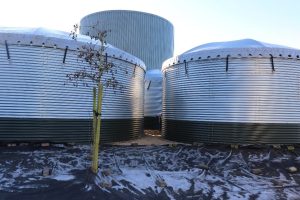
The installation of additional drain storage can take various forms. These can be cellars, silos or foil basins out of respectively concrete, metal silo structures or plastic (foil).
For installation, the following steps can be distinguished: installing the foundations or concrete tiles, placing silos, connecting silos with the necessary piping and covering the silos. Although such silos are above ground, most of these silos are still buried about 60 cm.
Landscape integration
This storage technique creates an impact on landscaping where metal storage silos are visible above ground. If they were underground concrete tanks or cellars, the effect on landscaping would be negligible because everything would be underground.
Maintenance
It is advisable to check the silo annually for damage. Be watchful of rusting, leaning and especially leakage (Maintenance and inspection of water storage silos – Groosman Water Silos | Groosman Water Silos).
Silos should ideally be cleaned at the end of each growing season. This involves removing any accumulated sludge and cleaning the entire storage tank. It is important to do this at least every year so that this sludge does not become a food source for all kinds of micro-organisms and you preserve the maximum storage capacity of drain water. This sludge can also start to accumulate more when the backflush water of the filter re-enters the dirty drain water silo.
Indicative prices for construction and other costs
Quotes were requested for a construction with corrugated metal sheets. The cost of three drainage silos (of 100 m³,100 m³ and 200m³): total €61 000 – €89 000 (quote 2021). Expressed per m³ of storage, this becomes €153-223/m³ water volume.
Relevant subsidy channels
For investing in the storage of used drain water with the aim of reuse, 30% of the investment cost can be subsidized by VLIF support. This can be done for both concrete structures and structures with corrugated metal sheets.
Economic benefits
To determine the value of drain water, we consider the price of the quantity of water and the price of the nutrients the water still contains. The price of tap water and groundwater is respectively 2.2113 €/m³ and 0.051 €/m³(PIDPA, 2025). In addition to this, 1 mS/cm (unit for Electrical Conductivity EC) of nutrients has a value of 0.5 €/mS/cm/m³ (van Os et al.,2012). A more recent article gave a price increase of about 40% (YARA, 2022).
The drain water of a tomato crop sits on average around 4.5 mS/cm and is thus worth about 2.3-5.4 €/m³. The drain water of a bell pepper cultivation sits on average around 3.5 mS/cm and is thus worth about 1.8-4.7 €/m³. The drain water of a strawberry crop sits on average around 1.5 mS/cm and is thus worth about 0.8-3.3 €/m³. For each specific situation it is possible to calculate the required dimensions of your drain storage to ensure adequate re-use and close the loop. The necessary dimensions depend on the current situation at your greenhouse, the crop, the capacity of your filtration and your already existing drain storage.
Ecological benefits
These investments thus save and reuse large amounts of water.
These investments thus save and reuse large amounts of water.
For sweet bell pepper, over a full year, about 222-400 l/m² of drain water is recovered and reused in the cultivation. For tomatoes, depending on the cultivation system, about 330-600 l/m² of drain water is recovered and reused in the cultivation over a full year. This drain water does have a considerable value due to the amount of water and nutrients it contains and ensures that you won’t have to rely on other water sources.
Relevant legislation, permits
When installing additional drain storage in outdoor silos, attention must be paid to influence of ambient temperature. In winter this makes the outdoor silos quite cold to store water in, so then you have to pay attention to the water flows on your farm. However, the outdoor silos can still be used to store drain water. The reuse of drain water is achieved with the cellars because they are less affected by ambient temperatures. In the warmer periods of the year, this does make it suitable to reuse from.
Sources for information & guidance
For the table of required drainwater storage capacity according to the crop and cultivation system (Table 1).
Table 1: the table of required drainwater storage capacity according to the cultivation and cultivation system (source: Decision of the Flemish Government on further rules around horticulture implementing the Decree of 22 December 2006 on the protection of water against pollution by nitrates from agricultural sources; Date 10/10/2008)
| Cultivation | Required drainwater capacity for systems without recirculation | Required drainwater capacity for systems with recirculation |
| strawberries under glass | 240m3/ha | 20m3/ha |
| strawberries under plastic | 130m3/ha | 20m3/ha |
| eggplant | 750m3/ha | 30m3/ha |
| azalea | 270m3/ha | 45m3/ha |
| tree nursery | 270m3/ha | not applicable |
| green and flowering plants | 630m3/ha | 20m3/ha |
| woody small fruits, other than strawberries | 113m3/ha | 15m3/ha |
| cucumber | 750m3/ha | 30m3/ha |
| other crops | 750m3/ha | 30m3/ha |
| bell pepper | 750m3/ha | 30m3/ha |
| save | not applicable | 30m3/ha |
| cut flowers | 2400m3/ha | 400m3/ha |
| tomato | 750m3/ha | 30m3/ha |
Farmers using a growing medium for cultivation under permanent or non-permanent canopy must have a storage capacity at least equivalent to the spray flow produced for 6 months (Manure Decree, 2025).
An Environmental Permit must be obtained and, if applicable, an earth-moving regulation(Use of soil materials (earth-moving)).
- Sources/Studies
Glastuinbouwwaterproof, 2019 ,Notitie verwijderen slib uit drain(age)silo’s [online] Beschikbaar op: Note_4_Boil sludge_draintanks.pdf
VLIF-steun voor productieve investeringen in het waterbeheer (https://lv.vlaanderen.be/subsidies/vlif-steun/vlif-investeringssteun-voor-land-en-tuinbouwers + attachment https://lv.vlaanderen.be/sites/lv/files/2025-07/VLIF4%20Codelijst%20blok%2003-2025%20-%20versie%20250718.pdf)
Mestdecreet, 2025 ; Hoofdstuk III Maatregelen van bijlage II en bijlage III van de nitraatrichtlijn ;Afdeling II De capaciteit.nl/…/Notitie_4_Bodemslib_draintanks.pdf de opslagtanks Article 9 § 2. https://codex.vlaanderen.be/PrintDocument.ashx?id=1015329&geannoteerd=false#H1034569
Water Portal, 2025 [online] Available at: https://www.waterportaal.be/WATERBRONNEN/Alternatievewaterbronnenpersector/Substraatteeltglastuinbouw.aspx
Water Portal, 2014, Brochure growing without drainage in greenhouse horticulture [online] Available at: Growing without drain in greenhouse horticulture | Brochure
van Os E., Jurgens R. , Appelman W. , Enthoven N. , Bruins M. , Creusen R. , Feenstra L. , Santos Cardoso D. , Meeuwsen B. , Beerling E.; (2012); Technische en economische mogelijkheden voor het zuiveren van spuiwater
YARA,2022; [accessed online on:01/09/25], Available at: https://www.yara.nl/gewasvoeding/uitgelicht/glastuinbouw/yara-glasactueel-17/wat-gaat-de-kunstmestprijs-in-2022-doen/
Our partners






