Cover materials for basins
Why?
Flemish greenhouse horticulture is heavily reliant on rainwater for irrigation. Due to climate change, periods of drought are becoming more frequent and water availability is coming under increasing pressure. Open water basins can lose up to 400–450 l/m² of water annually through evaporation. Traditional covers using black tarpaulins do not sufficiently limit these losses and bring additional disadvantages, such as algae growth, microbial contamination and the attraction of water birds. Research was therefore conducted to investigate the extent to which innovative floating cover materials can contribute to more efficient and sustainable water management.
What
How
Cost
Benefits
Attention
Description & visualization of technique
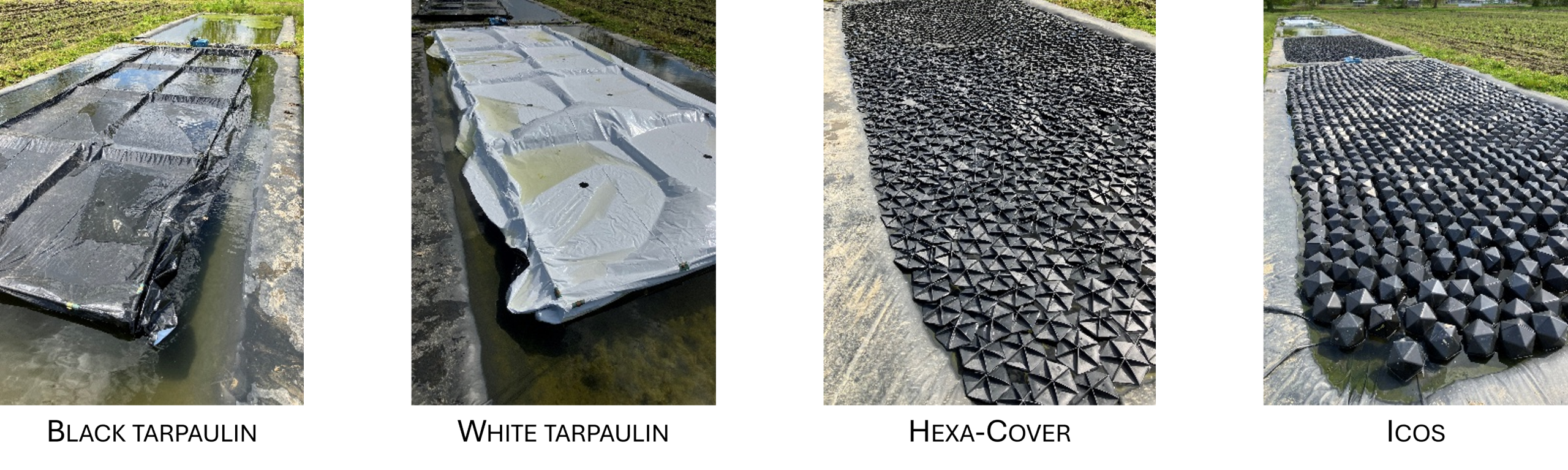
In this trial, various cover materials for water basins were compared:
- Black tarpaulin;
- White tarpaulin;
- Hexa-Cover (floating hexagonal panels);
- ICOS cones;
- Open basin as a reference.
The aim was to determine which systems are most effective at limiting evaporation losses whilst offering additional benefits such as lower water temperatures and reduced algae growth.
Construction (materials, technical sheet / cross-sections)
At the Vegetable Crops Research Centre (PSKW), six identical mini-basins were constructed in which the various covering systems were tested. From April 2023 to December 2025, the water level and water temperature were continuously measured using pressure and temperature sensors. Precipitation was monitored via a nearby Royal Meteorological Institute (KMI) station.
The trial results show that ICOS cones were the most effective system. Over three years of measurement, they achieved a reduction in evaporation of between 60 and 75% compared to open basins. This corresponds to a water saving of approximately 270–315 l/m². Hexa-Covers reduced evaporation by approximately 20%, whilst black and white cover sheets performed only marginally better than open basins.
In addition, the covering materials resulted in lower water temperatures and reduced algae growth. In particular, virtually no algae growth was observed with ICOS cones and Hexa-Covers.
Landscape integration
The trial was carried out using six identical mini-basins with a volume of 21.8 m³ and a maximum depth of 80 cm. The various covering systems were installed on the basins separately so that their effects could be compared objectively. When used in real-world basins, the covering materials must fit snugly against the water surface and be resistant to wind and weather conditions.
Indicative prices for construction and other costs
The cost of a cover system for water basins depends on the type of material, the surface area of the basin, the installation method and the desired lifespan of the system.
For traditional floating covers used in greenhouse horticulture, the guide price is generally between €15 and €50 per m².
For innovative floating cover systems such as Hexa-Covers and ICOS, the cost is higher, in the region of €30 to €45 per m².
Relevant subsidy channels
The Flemish Government provides VLIF investment support for investments that contribute to increasing the resilience of agricultural holdings and promoting more efficient water use.
Further information and conditions regarding VLIF support for efficient water use can be found on the website of the Flemish Government – Department of Agriculture & Fisheries.
The list of eligible investments can be viewed via the following link: https://lv.vlaanderen.be/sites/default/files/attachments/subsidiabele_investeringslijst_1.pdf
Economic benefits
By minimising evaporation losses, a significant volume of rainwater can be conserved. ICOS cones, in particular, show great potential for increasing the availability of irrigation water and reducing dependence on external water sources.
Ecological benefits
The cover systems help to improve water efficiency and increase water availability. They also reduce algae growth, microbial contamination and the attraction of waterbirds. This, in turn, improves water quality in the reservoir. The purer the raw water used for irrigation, the fewer treatment steps are required for purification and disinfection.
Relevant legislation, permits
When investing in water basins and covering systems, the following must be taken into account:
- VLIF subsidy conditions;
- Any planning permission conditions;
- Regulations governing water collection and water use.
Sources for information & guidance
Website Vlaanderen – Departement Landbouw & Visserij: Duurzaam watergebruik in de pluimeehouderij
Our partners