
(Ecological) Basins
Why?
Storage facilities for rainwater have become indispensable for greenhouse growers, as they are required by the regional town planning ordinance to collect water. Also, the quality of rainwater is preferred to that of shallow groundwater.
What
How
Cost
Benefits
Attention
Description & visualization of technique
For outdoor growers, building water reservoirs is not common because it is an expensive investment and the need for continuous irrigation is limited because the soil has water holding capacity. Given the changing climate, this could possibly change in the future. This is to capture water in times of precipitation surplus for periods of precipitation deficit. In addition to the existing practice of rainwater basins, there is also the possibility of providing a fixed capture point for surface water (with or without treatment), although this setup is still experimental.
Water reservoirs can be implemented in different ways. For example, the most popular way to store water for the Flemish (greenhouse) (horticultural) grower is a lined basin. There are also other options such as a steel basin, underground water storage, or burying foil. In this fact sheet we focus on water basins. We make a comparative study of the most common lined basins and an ecological water basin.
Courant lined basin:
A lined basin is similar to a pond that has a plastic or rubber liner. Due to this non-permeable liner, mixing with groundwater is not possible. This is positive because in this way the quality of the water is guaranteed and the composition of the water remains constant. The foil itself is the most important part of this basin because it largely determines the lifespan of the rainwater basin. This foil must be UV-resistant and sufficiently resistant to any substrate. The disadvantage of this lined basin is that on the one hand no sustainable alternative exists yet for the foil and on the other hand by digging in this basin often drainage has to be done under this reservoir resulting in a greater impact on the environment. This foil must be UV-resistant and sufficiently resistant to contact with the subsoil.
Ecological water basin:
An ecological basin differs from a conventional lined basin in that the non-permeable foil is buried. Working without waterproofing is not an option, as this would be de facto groundwater extraction, with the associated legal restrictions. By burying the foil, the soil and slopes are made heavier, making continuous drainage unnecessary. However, temporary drainage must be carried out when the foil is installed so that it can be glued or welded under favorable conditions.
Reinforcement can be made with various materials: porphyry, lava or excavated earth (nutrient-poor bottom layer). In addition, gabions can be placed on the slopes to prevent subsidence. This type of construction offers the possibility of planting the basin, which is not only visually attractive but also creates habitat. Although this concept is less sterile than a common lined basin, it is less useful if water quality standards are very strict. In order to guarantee water quality, it is possible to add a purifying membrane field (or other type of purifying planting). Therefore, the type of construction and type of cultivation determine whether an ecological basin is workable.
Construction (materials, technical sheet / cross-sections)
Water storage is often located partly in the ground and partly above ground. The shape of the basin can be of any shape. Classically, a rectangle is chosen, although less geometric shapes are also possible (with limited additional cost due to loss of material). The slope (= embankment of the basin) is usually 45°. For an ecological lagoon, the slopes can be made more gentle so that aquatic life can enter and leave the lagoon easily. Usually a drainage is laid under the lined basin. Drainage is performed to keep groundwater below the bottom level of the basin when the basin is excavated deeper than the groundwater level. Especially if there is little water in the basin, the pressure from below can become too great. From this, water or air bubbles form under the liner, which can cause this liner to come loose from the bottom. In the worst case, this can cause the liner to tear. With an ecological basin, this problem occurs only during installation (the reinforcement makes continuous drainage unnecessary).
Then the basin is excavated and the embankments placed. Often this is made from mineral soil rather than soil with organic material that can still decompose.
The available area of the basin can go in basically any direction, but the embankments usually have fixed dimensions. The slopes are usually placed in 45° and are often one meter wide and the depth of this basin is usually between 4-5 meters. After this, the liner is placed starting from the center of the pond and then folded out to just over the edges of the embankments. In a classic lined basin, the edges of the slopes are lined with water-permeable liner, if not, a trench or drainage system must be dug next to the slopes to allow runoff water to drain away. This foil must be UV-resistant and sufficiently resistant to contact with the subsoil
The liner itself is the most important part of this basin because it largely determines the lifespan of the rainwater basin. This liner must be UV-resistant and sufficiently resistant to any substrate. Four different materials are compared below:
- EPDM (Ethylene-Propylene-Diene-Monomer) is a synthetic rubber or elastomer that comes in thicknesses from 0.7 to 2.0 mm. EPDM has the property of being strong, flexible, resistant to UV light and has a long life of 30-50years. If the film cannot be made in one piece, it is possible to fix any seams or overlaps using primer and rubber adhesive. The downside is that EPDM is relatively heavy (1 to 1.5 kilograms per square meter).
- PVC (Polyvinyclhoride) is cheaper than EPDM, but has a shorter lifespan than EPDM (10-20 years). It is, however, flexible and therefore easy to work with. This material contains plasticizers that keep the material flexible, but after a few years it becomes stiffer and this film may break in the event of bending. Due to the short lifespan of this material, this film is often not chosen. This film comes between 0.5 to 1 mm thickness.
- HDPE (high density polyethylene film) is most commonly used for film basins. HDPE is not easy to install because it is a fairly stiff material. It is very strong and contains no plasticizers. Moreover, it also has the same lifespan as EPDM (30-50 years). Also, this material is resistant to UV-radiation. A thickness of 1.5 mm is often used for the implementation of a foil pool.
- Bentonite mats are an alternative to the above materials. Note that these mats must be buried at least 25 cm to be waterproof. Also, they cannot be placed below groundwater level.
Finishing the supply and drain pipes is an important issue. It must be ensured that these are finished watertight. This way, water will not run off in unwanted places.
Location
Usually a water basin is placed on the available area of a plot. This should also take into account the distance from trees to avoid leaf fall (eutrophication). It should also be checked that the location is not in ecologically valuable areas. If the foregoing is not limiting, the desired volume of stormwater to be collected is considered. The desired volume of water to be collected by the cistern depends on both the water use and the collection capacity of rainwater.
Water consumption is highly dependent on the crop or growing systems used. The collection capacity, in turn, depends on the amount of runoff water, collection, evaporation and overflow losses.
The standard lined basin has an overflow and a suction line. The area between these is the useful volume of rainwater that can be used for cultivation (see photo). A simulation of the desired dimensioning for a standardl ined basin was worked out in a WADITO tool taking into account possible loss items around collection and storage of rainwater. The practice centers use this tool and can be contacted for a simulation.
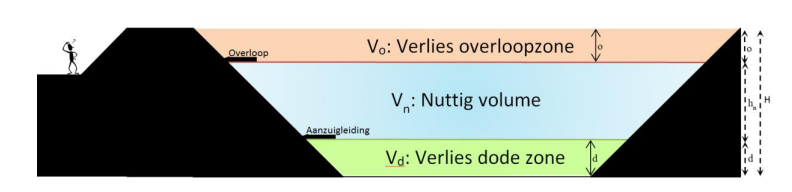
Figure 1: cross-section of the lined basin with its utilizable and non-utilizable volumes. Thesis Stan Verdonck
Landscape integration
A lined basin has a nationwide effect, as it is partly above as well as underground construction. An environmental permit must therefore also be obtained for this procurement.
An ecological basin also requires a permit. However, this offers more opportunities for landscaping. It is preferable to plant or sow so that the basin is not colonized by pioneer species or invasive exotics. In the water, spurge, hornwort, frogbane, crabberry and water gentian can be used. On the edges, suitable species are: water mint, pondweed, water thistle, water strawberry , riparian sedge, marsh sedge, marsh marigold, kingwort, big cattail, whole-leaf, marsh roller clover, brook spike, marsh forget-me-not, …
Maintenance
When the basin water level reaches the intake line, the lined basin should be filled with water from other sources, usually this is groundwater.
Because groundwater is added, we will have varying quality of our feed water. Both PH and EC can vary as well as the accumulation of unwanted salts. This should be taken into account when making the nutritional schedules for greenhouse crops. Accumulation of salts is less of a problem with outdoor crops. Also, if the basin has reached its capacity it could overflow. This water should be allowed to infiltrate according to GSV guidelines.
When storing (rain) water in a lined basin, algae growth can be a problem that must be addressed in a timely manner. Algae growth is stimulated by the combination of stagnant water, light and heat the problem of algae growth often occurs. Algae development can be very strong when sufficient nutrients are present in the water. For example, algae growth is accelerated by the presence of fertilizers when drain water is collected. In practice, a variety of methods are used to control algae. The best solution is to shield the water from light, using a tension or floating tarp. Other options for algae control include using an ultrasonic device and introducing oxygen into the water. Another solution is to use rafts with adapted plants that absorb nutrients from the water on the one hand and limit light penetration and warming of the water on the other.
Indicative prices for construction and other costs
A lined basin is in a sense limited in terms of surface area versus usable volume of water. This is because the embankments usually have fixed dimensions. The embankments are usually placed in 45°, they are often one meter wide and the depth of this basin is usually between 4-5 meters. When more than 500 m³ needs to be stored, it is more interesting to place a lined basin than, for example, a water silo.
The biggest costs for a lined basin are the excavation and drainage work (pond, drainage, filters and pumps) and the foil itself. There is also the ongoing cost of electricity for drainage for a lined basin.
Relevant subsidy channels
VLIF and VLIF NPI.
Relevant legislation, permits
- Relief change. NOTE: embankment is also counted as soil intervention.
- Vegetation change
- Technical report if + 250 m3 of earthmoving
- VLAREBO (since 1/1/2023 integrated into the Decree on Soil Remediation and Earth Moving): Reuse of soil depends on the environmental health code of the soil (it must therefore be analyzed). If no contamination is found (environmental health code 211), the soil can be reused for agriculture and natural areas (destination types I and II). If contamination is found, there will be restrictions on where the soil can be reused.
- If the total area is + 1000m2: mandatory archaeological research (archaeological note and landscape borings). Cost price 2500 to 3000 euros. NOTE: 80% of the cost price is eligible if something is found during archaeological research.
Decision tree for this can be found here.
Our partners






