
Increasing The Use of Rainwater
Why?
Purified rainwater remains the best source of water for growers in terms of both quality and quantity. In order to make this water available to the maximum extent possible, it is necessary to have sufficient collection and storage capacity. Modern greenhouse horticulture intensifies the use of the available cultivation area through innovation and crop diversification. This increases the production capacity of the cultivation area, but also the demand for water. In certain crops and cultivation systems, water demand can exceed the average amount of precipitation during the year. Increasing the available storage capacity and linking this to additional roof area offers a solution to this problem. The additional roof area available to a grower varies, but can include both company-owned and external roof area. In both cases the goal remains the same: a horticultural business must strive for a precipitation collection capacity that is tailored to its water demand.
Sources
Aendekerk, T. G., de Wit, A. M., & van Lint, J. A. J. (2005). Water en ruimte: meervoudig ruimtegebruik in de boomteelt (No. 418). Praktijkonderzoek Plant & Omgeving BV. PAS; 2025 Waterportaal - Vergunningen Waterportaal - Dimensionering opvang hemelwater Waterportaal - Opslagmogelijkheden Aandachtspunten aanleg spaarbekkenWhat
How
Cost
Benefits
Attention
Description & visualization of technique
In a well-designed greenhouse, rainwater consumption is organised to provide crops with as much pure rainwater as possible. To achieve this, there must be sufficient collection and storage capacity.
Calculations of the required storage size can be carried out by the recognised agricultural research centres in Flanders.
After the tailored dimensioning, the excavation work, drainage pipes, embankments and basin liner can be installed.
Connecting additional roof area requires an extension to the rainwater pipe network, but this is fairly simple to do.
If you have multiple basins, it is a good idea to connect them passively to prevent unwanted overflows. Often, a bypass piece of pipe can be installed in the existing pipe network, making this easy to achieve without the need for pumps.
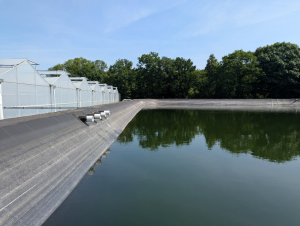
Construction (materials, technical sheet / cross-sections)
The construction of a foil basin makes it relatively easy to store large volumes of water. Installing a foil basin requires several phases:
- Planning and dimensioning (a recognised agricultural research centre can assist farmers with this)
- Depending on the local groundwater level, installing drainage
- Excavation of the pond and formation of the embankments
- Laying a film, such as HDPE film.
- Any additional facilities such as ventilation, pump and pipe network
In addition, choosing the location for the rainwater basin depends on several factors, of which the following are crucial:
- Soil (type): The height of the embankment of the foil basin is highly dependent on the bearing capacity of the soil used. On sandy and clay soils, this bearing capacity is high and this method of storage is very suitable (Aendekerk et al., 2005).
- Groundwater (pressure): The deeper you dig the basin, the greater the influence of rising groundwater. If the bottom of the basin is affected by groundwater, this can eventually cause the liner to float or even tear. Measures such as installing (adaptive) drainage are then likely to be necessary.
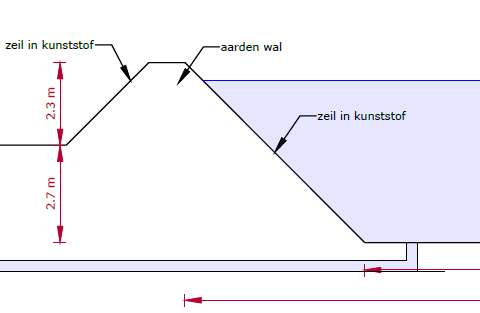
Landscape integration
In order to minimise the impact of the embankment of a basin on the landscape, the dimensions of the embankments must be taken into account. The higher the embankment can be made, the greater the volume of water that the basin can store, but in most cases an embankment will protrude between 1 and 2.5 metres above ground level (PAS, 2025).
Maintenance
Passively connecting multiple rainwater basins with an underground pipe is the simplest solution. If you already have multiple basins, you may be able to bypass a pump with an adapter to connect the basins passively. If this is not possible, the water levels in the various basins must be managed with a pump installation so that each basin is used optimally and overflows are avoided.
Indicative prices for construction and other costs
The main costs for a rainwater basin are related to its construction, as there are few ongoing costs associated with this implementation. For the construction of a basin, you can expect to pay approximately 9.30 €/m² of basin surface area or 4 €/m³ of water volume in the basin for the excavation work. For the installation of the basin, you should also expect to pay 21.63 €/m² of basin surface area or 9.35 €/m³ of water volume in the basin. If you also want to aerate your basin, an aeration system costs approximately 0.46 €/m³ of water volume in the basin. The total investment cost for a basin is therefore 13.82 €/m³.
Lifespan of a pond: an average foil pond lasts approximately 20 years. This is mainly influenced by the strength of the foil.
Relevant subsidy channels
The Flemish subsidy of the VLIF non-productive investment (NPI) may be an option to help finance up to 50% of the costs. For fruiting vegetables and cut flowers grown under glass this only applies to water volumes above 3,500 m³/ha of cultivation. For the cultivation of leafy vegetables and ornamental plants under glass this applies to water volumes above 1,500 m³/ha. (Source: 20250120 Fiche NPI – wateropslagsystemen.pdf).
Economic benefits
The main benefit of this investment in the expansion of rainwater collection and storage is self-sufficiency in high-quality irrigation water. Your own water supplies may be insufficient and in the future you may not be able to claim alternative water sources due to possible collection bans or problems with the renewal of permits. In that case, investing in an expansion of your rainwater reserves is a logical step.
In addition, increased use of rainwater means fewer harmful elements – such as iron, bicarbonate, sodium and silicon – in your water system (e.g. originating from groundwater). Reuse of groundwater-based drainage can potentially lead to the production of effluent water, which must be discharged, due to the accumulation of the aforementioned elements.
Ecosystem services, biodiversity
Increased use of rainwater will result in reduced consumption of alternative water sources such as groundwater or tap water. In addition, the use of rainwater also has an impact on the environment, where properly dimensioned basins will result in fewer instances of flooding during the winter period, given the reduction in rainwater runoff.
Relevant legislation, permits
- Regional Rainwater Regulation 2023 (GSV hemelwater 2023):
The legislation with which a rainwater basin and a company’s infiltration facility must comply.
- Provincial regulations:
One of the provincial regulations is the provincial policy framework for water advice for the province of Antwerp. This legislation imposes a stricter limit on the reduction of roof surface area for large users of rainwater. The reduced roof area that must be taken into account when dimensioning the infiltration facility may be reduced by a maximum of 5,000 m².
- Buffer and infiltration facilities:
A rainwater basin is considered to be a paved surface with catchment. This means that the dimensions of the infiltration facilities need to be reviewed.
- Relevant legislation concerning permits:
An environmental permit must be applied for and, if applicable, a regulation for earthmoving.
Sources for information & guidance
Practical examples, such as the demonstration project at the Hoogstraten Research Centre (PCH) as part of Life ACLIMA.
Sources/studies:
- Aandachtspunten aanlag hemelwateropvang (2023); [Online] beschikbaar op: https://praktijkpuntlandbouw.be/wp-content/uploads/2023/06/Waterwijs-Stappenplan-Waaraan-denken-bij-aanleg-spaarbekken.pdf
- Aendekerk, T. G., de Wit, A. M., & van Lint, J. A. J. (2005). Water en ruimte: meervoudig ruimtegebruik in de boomteelt (No. 418). Praktijkonderzoek Plant & Omgeving BV. [Online] beschikbaar op: https://edepot.wur.nl/298053
- PAS; 2025; [Online] beschikbaar op: https://pasmestopslag.nl/app/uploads/2024/10/Folder_Foliebassin.pdf
- Studie rond afdekkingsmaterialen waterbassins; [Online] beschikbaar op: https://lifeaclima.eu/acties/actiec2-3/?gebruiker=landbouwsector
- Waterportaal – Dimensionering opvang hemelwater; [Online] beschikbaar op: https://www.waterportaal.be/WATERBRONNEN/Opslagwater/Dimensioneringopvangvanhemelwater.aspx#Dimensionering-glastuinbouw
- Waterportaal – Opslagmogelijkheden; [Online] beschikbaar op: https://www.waterportaal.be/WATERBRONNEN/Opslagwater/Opslagmogelijkheden.aspx
- Waterportaal – Vergunningen; [Online] beschikbaar op: https://www.waterportaal.be/WATERBRONNEN/Wettelijkkader/Vergunningen.aspx#Omgevingsvergunning-Aanleg-wateropslagsysteem
Our partners






