
Misting for Heat Stress in Dairy Cattle
Why?
Due to global warming, an increase in the number of summer days (over 25 degrees) and tropical days (over 30 degrees) is expected. Periods of prolonged and high temperatures lead to heat stress in farm animals.
Heat stress occurs when there is an imbalance between heat production in the animal and its ability to release this heat to the environment. This occurs once the upper critical temperature of the thermoneutral zone is exceeded, which is between 20-24°C for Holstein cows.
To reduce heat stress in dairy cattle, several measures can be taken:
- Ration adjustments
- Optimal and sufficient water supply
- Vent
- Additional cooling
During hot summer days, it is important to keep the climate in the barn optimal. With water-based ventilation and cooling systems, heat stress can be reduced with greater animal comfort and technical results can be better maintained.
Contact person
Stefanie Verherstraeten (Hooibeekhoeve)
What
How
Cost
Benefits
Attention
Description & visualization of technique
The degree to which cows experience heat stress depends not only on ambient temperature but also on relative humidity. The diagram below shows the temperature-relative humidity combination at which cows experience mild, moderate and severe heat stress. It is generally accepted that dairy cows experience heat stress at a THI>68.

The impact of heat stress on dairy cows is significant and manifests itself in several areas:
- Drinking water demand increases
Increasing water intake is one of the main responses of animals to increased ambient temperature. This water produces a direct effect on cow comfort by cooling the reticulorumen. Moreover, after absorption, much of this water is still used for heat loss through sweating and panting. Thus, tests have shown that animals under high temperatures show a much lower excretion of water through the manure, and greatly increased excretion through urine, skin surface and respiratory system. At temperatures >25°C, water requirements will increase by 30%.
- In lactating animals , milk production decreases, which may or may not be combined with lower fat and protein levels.
In mild heat stress (THI 68 – 71), in addition to accelerated respiration and increased transpiration, the cow will take in less feed accompanied by a 10% decrease in milk yield. At low to moderate heat stress (THI 72-80), feed intake and milk yield will decrease even more sharply (-25%). At severe heat stress (THI >80) the milk yield will decrease more than 25% and even death of the animals is possible.
- More health problems
Cows with heat stress will lie down less and absorb less feed. This leads to reduced rumen function and resistance of cows. They are therefore much more susceptible to rumen acidosis, udder infections and claw problems during periods of heat stress.
- Reduced fertility
Reduced feed intake due to heat stress can result in an extremely negative energy balance. This energy deficit and possibly increased body temperature, reduces egg quality and hormone production. Heat stress can lower the fertilization rate, normally around 90%, to 55%. In addition, early embryonic mortality is higher with heat stress. Starting at a THI of 69, early embryonic mortality can occur in more than 12% of embryos.
German research shows that with short-term heat stress, 37% of fertilizations fail. Over a longer period with heat stress, fertility decreases as much as 63%.
Initially, it is important to equip dairy barns with fans. These create wind displacement which has a cooling effect on the animals. The number and placement of the fans (transverse or longitudinal ventilation) depends on the type of barn and type of fan, the orientation of the barn relative to the prevailing wind direction, and any additional cooling. In practice, a company-specific ventilation plan will be drawn up.
In dairy barns, additional cooling via water can be used in addition to ventilation. Through soaking, the barn temperature goes down several degrees. Soaking is a system that will cool the animals directly by spraying them wet.
Construction (materials, technical sheet / cross-sections)
Atomization:
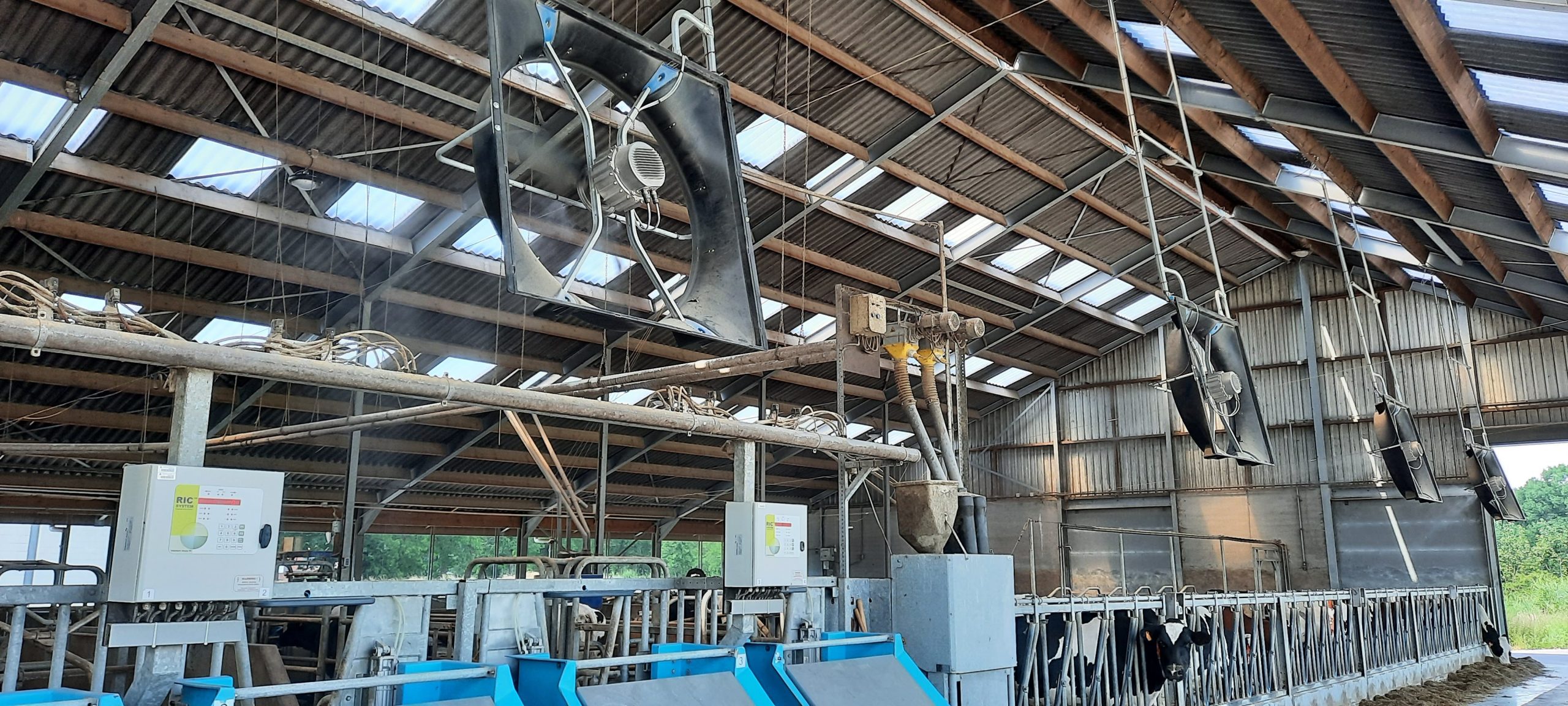
High-pressure misting systems are used to cool the air above the cow and not to wet the cow. By introducing water into the air in the form of fine water droplets, the water immediately evaporates. For this purpose, heat is extracted from the air and cools the air.
A ring with 6, 8 or 10 nozzles is attached to the fans. A high-pressure pump carries the water at a pressure of 70 bar to the nozzles, where it evaporates to a fine mist, absorbs the heat and carries it away from the cow. Depending on the humidity in the barn, a cooling of 3 to 5 degrees can be achieved. Important here are the regulation of humidity and the settings on the control equipment. The cattle and the barn should not get wet. Nebulization can be started at a temperature >27°C and stops at an RH of 70-80%. A higher RH is unhealthy.
The combination of temperature and relative humidity in the barn is very important! Due to evaporation of the fine mist, the relative humidity in the barn does increase. It is important to monitor this carefully. When the relative humidity exceeds 70 to 80%, it is appropriate to stop cooling for dairy cattle.
Atomization is usually linked to the humidity and temperature control of a climate computer. For stand-alone systems, the system is controllable via interval setting. In both cases it is very important to keep a close eye on the effective climate in the stables as well as the behavior of animals during the heat period.
The finer the mist, the faster the water evaporates and the better the cooling. Therefore, it is better to provide more nozzles with finer mist than fewer nozzles with coarser mist.
Soaking:
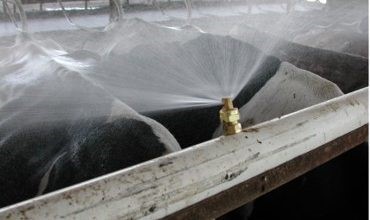
Soaking systems wet the cows with large drops, then fans blow air over the cow’s body. This evaporates the water and cools the cows. In most cases, a pipe is installed at the feed fence with nozzles (sprinklers) that spray water at low pressure and a 180-degree angle over the cows’ backs. A spray pattern with a radius of no more than 2.40 m is desirable in this regard so as not to wet the running barn.
The size of the sprinklers determines water consumption. Proper pipe diameters, pressure regulators, thermostats and timers are also required for a properly functioning system. Soaking starts at 28°C and then ventilation stops temporarily. Soaking is applied or not applied at time intervals.
(Photo: https://www.abbi-aerotech.com/nl/oplossingen-voor-melkveestallen/koeling/)
Maintenance
Combination of temperature and relative humidity in the barn is very important! Due to evaporation of the fine mist, the relative humidity in the barn does increase. It is important to monitor this carefully. When the relative humidity exceeds 70 to 80%, it is appropriate to stop cooling for dairy cattle.
Atomization is usually linked to the humidity and temperature control of a climate computer. For stand-alone systems, the system is controllable via interval setting. In both cases it is very important to keep a close eye on the effective climate in the stables as well as the behavior of animals during the heat period.
The finer the mist, the faster the water evaporates and the better the cooling. Therefore, it is better to provide more nozzles with finer mist than fewer nozzles with coarser mist.
Indicative prices for construction and other costs
Prices for the installation of a misting or soaking system depend on the size of the barn and the type.
Atomization:
Dairy barn 120 cows: order of magnitude: 5000-6000€.
Soaking:
Dairy barn 120 cows: size order: 2,500-3,500€.
Prices listed are indicative and based on July 2022 target prices.
Relevant subsidy channels
For investments that contribute to increased farm resilience, the Flemish Government provides VLIF investment support.
More info and conditions on VLIF support can be found on the website of the Flemish Government – Agency for Agriculture & Sea Fisheries(https://lv.vlaanderen.be/nl/subsidies/vlif-steun/vlif-investeringssteun-voor-land-en-tuinbouwers).
The Flemish Government provides VLIF investment support for investments in systems for cooling (including mist cooling and pad cooling). These can be found in the eligible investment list(https://lv.vlaanderen.be/sites/default/files/attachments/subsidiabele_investeringslijst_1.pdf).
Economic benefits
At Hooibeekhoeve, a misting system was installed in the dairy barn. Small nozzles (2 mm) were mounted on the fans. The misting installation starts automatically as soon as the temperature in the barn rises above 27°C and switches off when the relative humidity rises to 70-80%. The results from the summer of 2024 are promising. Between July and September, the system was active for 21 days: 78.5 hours in barn 1 and 62 hours in barn 2. Although there were no prolonged heat waves that summer, a remarkable temperature difference was measured. Temperatures up to more than 8°C below the outside temperature were observed in barns with misting. Also, the observed temperature was up to 3 to 4°C cooler than in barn area without misting. Water consumption was about 1 liter per minute per fan. Next summer, water consumption, temperature and relative humidity will be further monitored. These first results already show that fogging can be an effective measure to reduce heat stress.
Heat stress in dairy cattle impacts animal welfare and production: decreased feed intake, decreased milk production, decreased fertility and resistance. Reducing heat stress through cooling reduces production losses and health and animal welfare problems. This reduces expenses and increases income.
Ecological benefits
Heat stress in dairy cattle has an impact on animal welfare and production: decreased feed intake, decreased milk production, decreased fertility and resistance. Reducing heat stress through cooling reduces production losses and health and animal welfare problems
Our partners






