
Spray cooling for poultry
Why?
Due to global warming, an increase in the number of summer days (over 25 degrees) and tropical days (over 30 degrees) is expected. Periods of prolonged and high temperatures lead to heat stress in farm animals.
Within the poultry sector, heat stress is a hot topic with increasing concern. Indeed, chickens are more sensitive to higher temperatures than other farm animals due to their physiology. Heat stress has a direct effect on mortality rates and affects feed intake as well as nutrient utilization, reducing the number of eggs produced and kilograms of chicken meat. Moreover, heat stress also has an additional negative effect on egg and meat quality.
To reduce heat stress, several measures can be taken:
- Optimizing barn climate through ventilation and cooling
- Adjusting nutrition
- Administration of drinking water supplements
- Lowering occupancy density
During hot summer days, it is important to keep the climate in the barn optimal for poultry. Water-based cooling systems can prevent excessive mortality and better maintain technical results.
What
How
Cost
Benefits
Attention
Description & visualization of technique
Poultry barns can be cooled with water during warm periods with high outside temperatures. There are 2 common systems for this in practice: spray cooling where a fine spray of water is introduced into the barn and pad cooling where the incoming flows through a wet package (plastic or cellulose) placed in front of the air intake.
Spray cooling (inside and outside the barn)
Spray cooling is a common cooling system in practice. With spray cooling, a high-pressure spray system is usually chosen inside the barn. A low-pressure system can also be placed outside the barn. Both systems have the same operating principle: by introducing water into the air in the form of fine water droplets, the water evaporates. For this purpose, heat is extracted from the air and cools the air. In addition, the spray also has a cooling effect on the chickens themselves.
Spraying is controlled with pulse pauses, with more being sprayed as it gets warmer. In this way, you do not have to wait until the barn temperature is high, but can start from 24°C, for example, and systematically build up the spraying duration as the temperature rises.
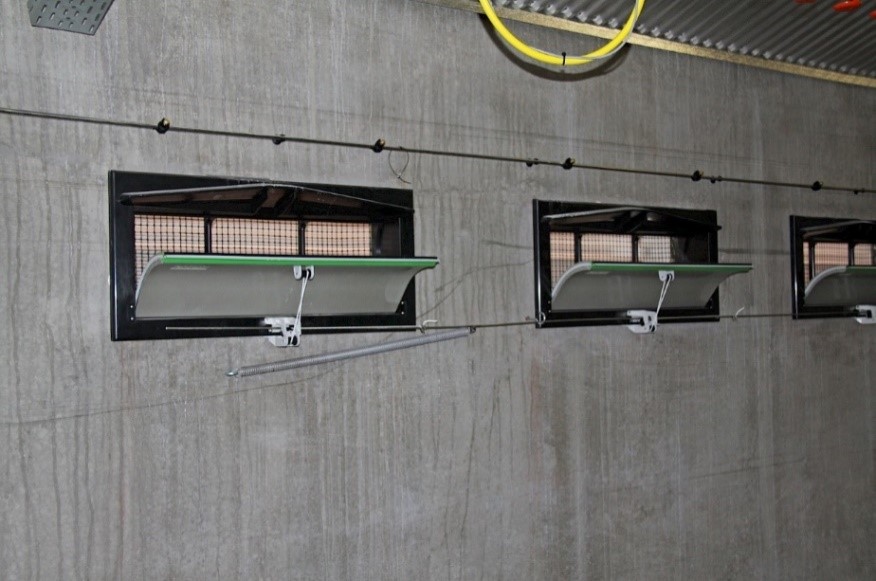
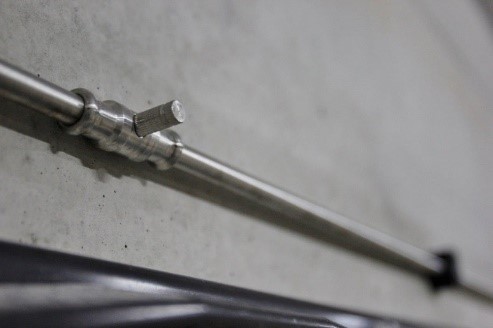
Spray cooling with spray nozzles at the level of the air inlet valves (Photo Experimental Poultry Centre)
Construction (materials, technical sheet / cross-sections)
Spray cooling
The spray cooling system is mounted in the barn along the length of the barn with spray nozzles above the inlet valves. By creating a fine spray around the valves, the incoming air is cooled back several degrees. The finer the spray is, the greater the cooling effect.
Advantages
Spray cooling has an immediate cooling effect on the chickens. In addition, the system can also be used to create optimal relative humidity of the barn air for the chicks at the beginning of the round. In addition, the system is also often used to soak the houses before cleaning the house.
Outdoor cooling using spray, using a low-pressure system, is a cheaper and simpler alternative than the indoor version. However, the effect on incoming air is lower with this cooling system.
Disadvantage
Due to calcification, the small openings in the nozzles can easily plug up. Therefore, it is important to regularly check the operation of the system and, if necessary, clean the nozzles with a limescale-dissolving agent (for example, vinegar) to keep them open. If necessary, the nozzles should be replaced.

Fogging system in the broiler house (photo Experimental Poultry Centre)
Pad cooling
The system of pad cooling works by evaporating water in the warm outside air. The outside air is drawn through a wet pack of treated cellulose or plastic.
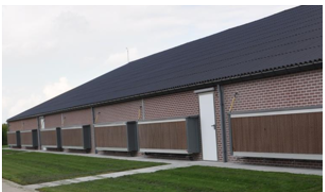
Pad cooling at the broiler house (Photo Experimental Poultry Centre)
Above the pad unit hangs a tube that distributes the water evenly. At the bottom of the unit, the water is collected and reused. The outside air absorbs the water by evaporation and thus cools down about 6-10 degrees. This depends on the temperature difference between the outside air and the barn air and the relative humidity.
It is important to closely monitor the relative humidity in the barn. After all, as with spray cooling, this system brings extra moisture into the house. If humidity is too high, the chickens can no longer release their excess heat. Also make sure the house is airtight, because the more air that passes through the pad cooling system, the greater the cooling effect on the warm outside air.
Ideally, the incoming air first enters a kind of “front room” after which it passes through the valves into the barn. This way the air can be better controlled with the position of the valves and the negative pressure. This also prevents the litter behind the pad units from getting wet too quickly.
Advantages
Pad cooling is an efficient system that allows controlled cooling of incoming air.
There is no direct atomization of water in the barn, reducing the risk of wet spots.
Disadvantages
It is important to carefully monitor the water level of the pad chiller. After all, a too high water level can cause the chicks right behind the pad chiller to be too cold which poses a risk to their health.
The system is more expensive to purchase than spray cooling.
The system is sensitive to frost. Therefore, take appropriate measures in the fall to prevent frost damage.
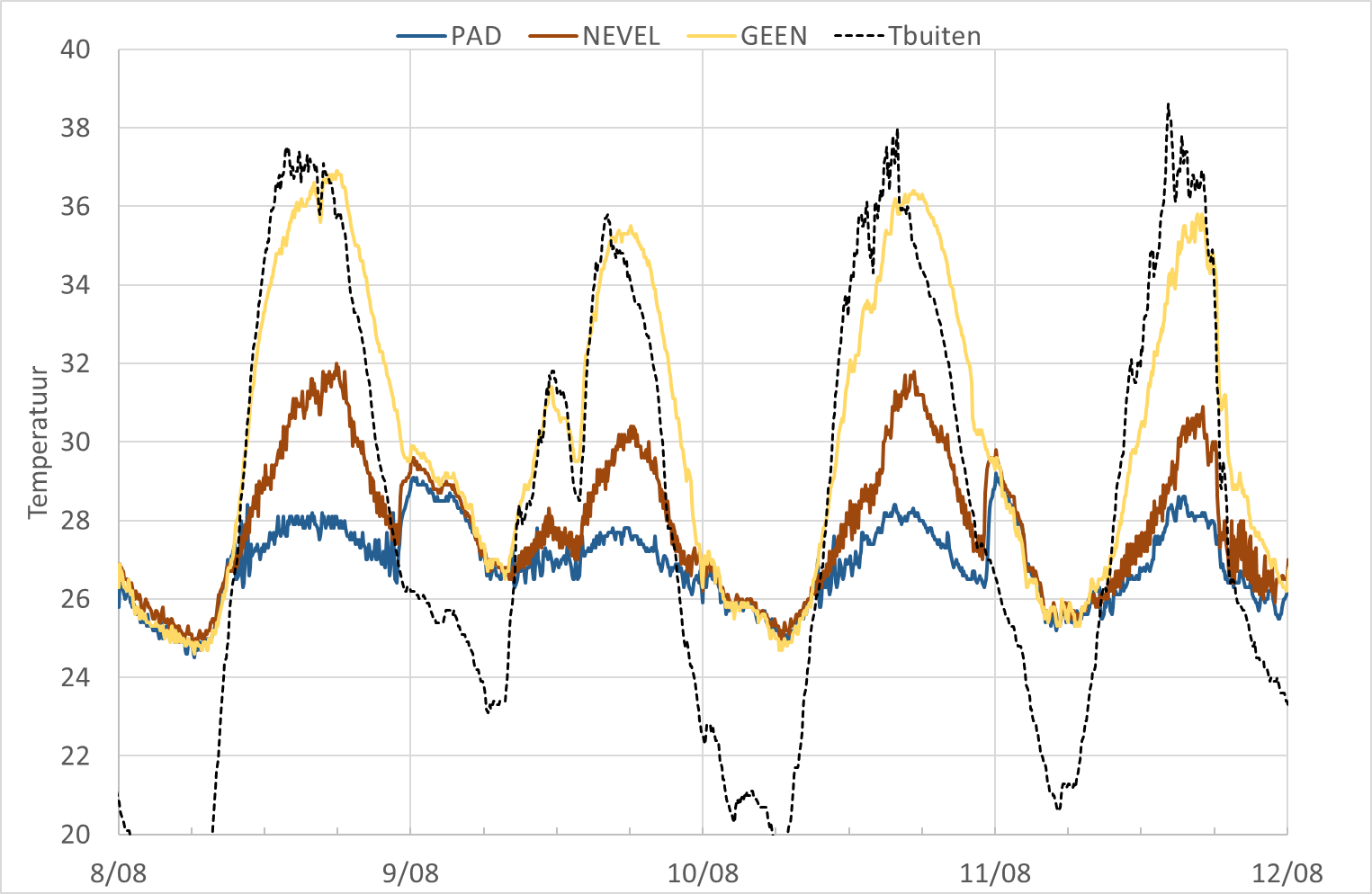
This graph shows the temperature course in summer at high outdoor temperatures (outside). We see the temperature course in the barn without cooling (Geen), with spray cooling (NEVEL) and pad cooling (PAD). With water cooling, temperature reductions of 3.5 to 7.5°C can be achieved.
Indicative prices for construction and other costs
Prices for the installation of a spray cooling or pad cooling system depend on the size of the barn and the type (broilers, laying hens).
Spray cooling :
Broiler house (regular house – 50.000 birds): €11.500
Laying hen house (aviary house – 30.000 birds): €8.500
Path cooling:
Broiler house (regular house – 50.000 birds): €29.500
Laying hen house (aviary house – 30.000 birds): €16.000
Prices listed are indicative and based on July 2022 target prices.
Relevant subsidy channels
For investments that contribute to increased resilience of the agricultural company, the Flemish Government provides VLIF investment support.
More info and conditions on VLIF support can be found on the website of the Flemish Government – Department of Agriculture & Fisheries(https://lv.vlaanderen.be/nl/subsidies/vlif-steun/vlif-investeringssteun-voor-land-en-tuinbouwers).
Economic benefits
Heat stress in poultry impacts technical performance (feed intake, growth, number of eggs produced, mortality rate) but also negatively impacts egg and meat quality, making the final product less marketable for retail or hatcheries.
By countering heat stress, there is less failure of animals and increased performance, increased product quality and fewer welfare and health problems will be noted. This is crucial for the industry, but also for society, to ensure that the poultry sector remains socially accepted.
Relevant legislation, permits
Combination of temperature and relative humidity in the barn is very important! Due to evaporation of the fine spray, the relative humidity in the barn does increase. It is important to monitor this carefully. When the relative humidity is higher than 85 to 90%, it is even advisable to stop cooling. The hens can then no longer release their heat and the desired effect is not achieved.
Atomization is usually linked to the humidity and temperature control of the climate computer. For stand-alone systems, the system is controllable via interval setting. In both cases it is very important to keep a close eye on the effective climate in the stables as well as the behavior of animals during the heat period.
The finer the spray, the faster the water evaporates and the better the cooling. Therefore, it is better to provide more nozzles with finer spray then fewer nozzles with coarser spray.
The greatest evaporating effect is obtained by absorbing the spray directly into the air stream. It is therefore best to place the nozzles above the inlet valves. For wide barns, an additional pipe can be provided in the middle of the barn.
Avoid clogging the nozzles by placing filters with different finenesses in front of the cooling system. This gives the least chance of clogs and leaks. Check the filters regularly and replace them if necessary.
Our partners






