
Sensor-controlled Irrigation
Why?
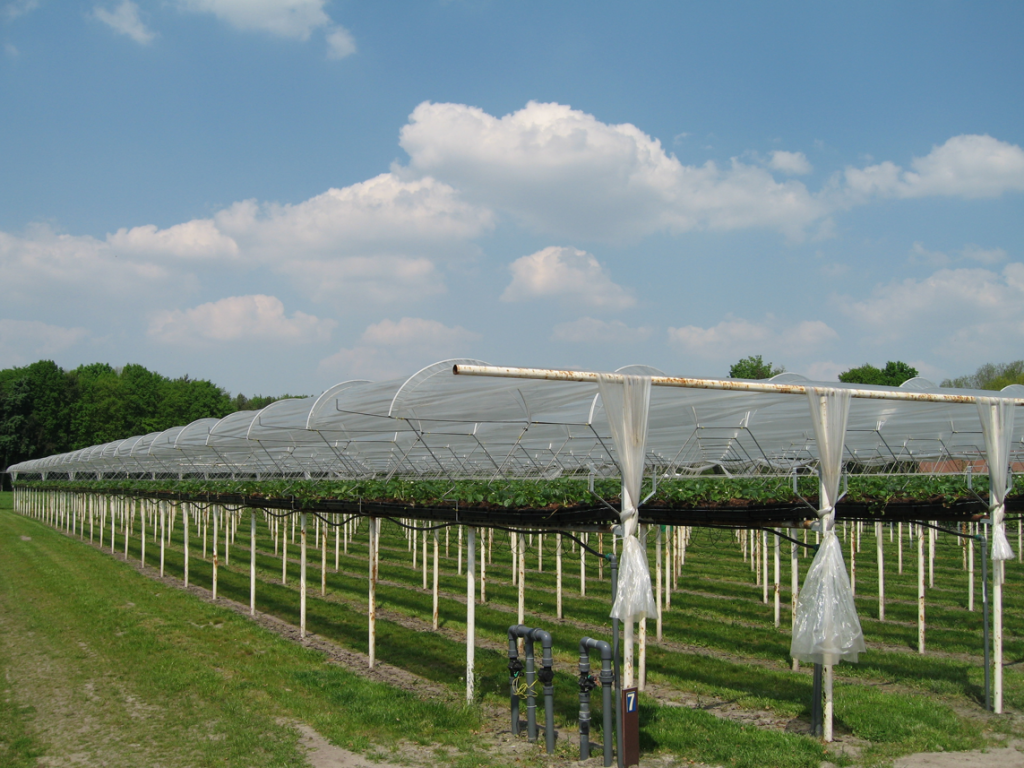
Strawberries on substrate have a very closed water system. Drain water in greenhouses is collected and, after disinfection by mixing with rainwater, reused as the basis for new fertigation water. The only common substrate cultivation with drain water losses are tabletops with free seepage. These crops now have similar watering than greenhouses and also produce between 15-30% drain water, water rich in nutrients that seeps into the underlying grass cover and can enrich both ground and surface water. With good grass cover, the chance of seepage is virtually zero given the cultivation period between April and September. But even with good grass cover, mowing remains necessary and disposal of the clippings is often not done, causing nitrogen enrichment in the soil. Nitrogen-rich soils are a threat to biodiversity and can cause leaching to groundwater during wetter periods of the year. Sensor-based watering on such tabletops adds value by better matching plant needs and minimizing drain rates.
What
How
Cost
Benefits
Attention
Description & visualization of technique
A substrate sensor provides real-time data on key parameters in the root environment, being water content, substrate temperature and EC. Based on this data, we can tailor fertigation specifically to the needs of the crop and avoid direct water losses through free seepage due to too much or too long fertigation rounds. Today, growers measure drain quantities to calculate the drain percentage to make decisions on how to adjust fertigation together with data on the EC in the drain water. A substrate sensor that frequently (every 5 minutes) records values around humidity and EC in the substrate can save the grower work and allow him to be more responsive when the busyness of the farm does not allow for frequent enough determination of the drain percentage. Through an online dashboard, graphs can be retrieved regarding the moisture content or EC and how it progresses over time. Provided some thresholds are set, timely adjustments in fertigation can then be made to provide the root zone with sufficient water.
Construction (materials, technical sheet / cross-sections)
In 2 trials at Proefcentrum Hoogstraten, Sigrow substrate sensors of the SoilPro mini type were used to monitor data from the root zone in strawberry crops. Sigrow provides with the substrate sensor real-time data on relative humidity, PAR light (on the sensor), air temperature, substrate temperature, substrate humidity, irradiance on the sensor, daylight integral and substrate EC. Only humidity and substrate EC were used in the trials. Installation is simple.
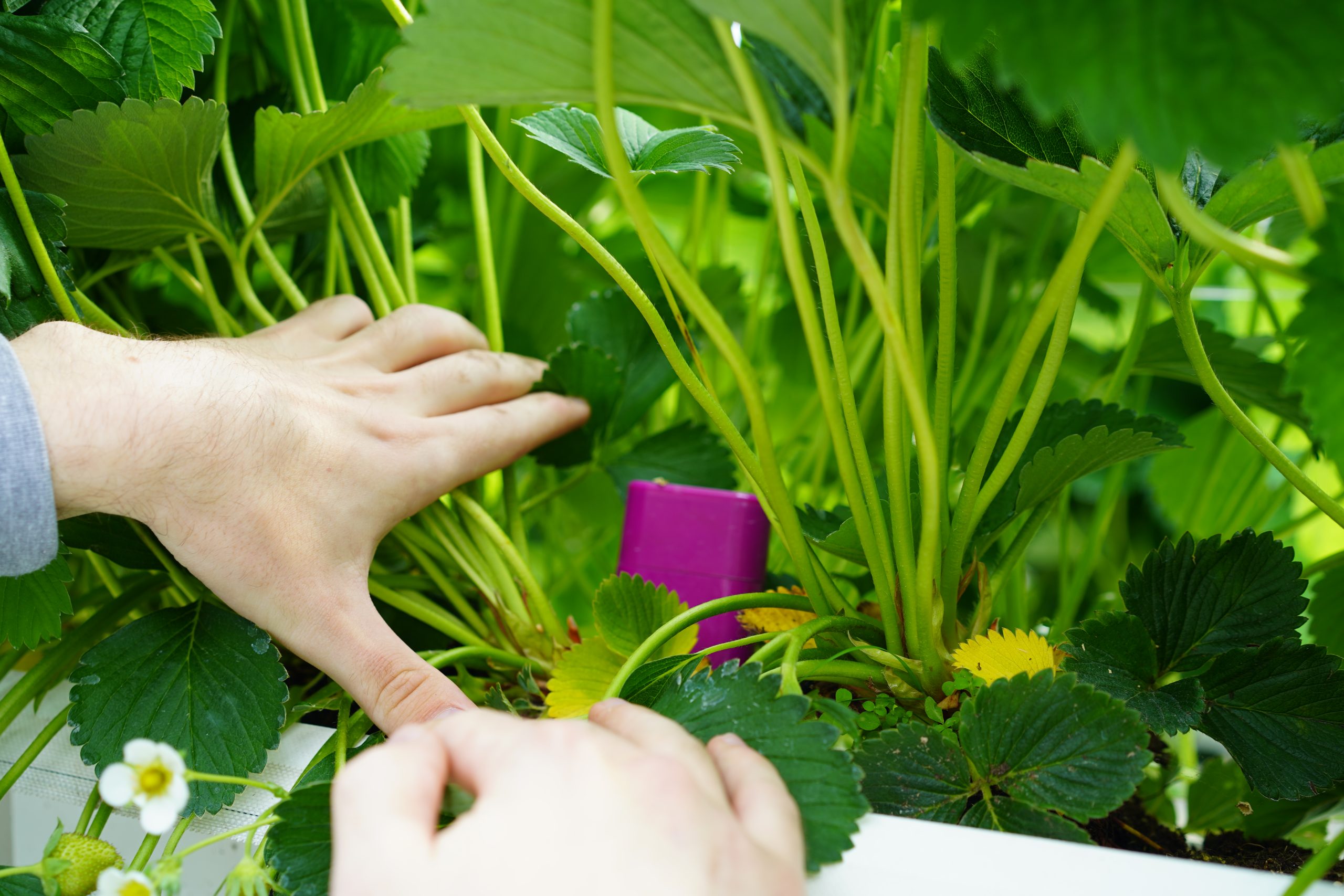
The sensor is pricked into free substrate in between root zones. The needles should reach the center of the substrate. To properly track an object, it is best to place about 3 sensors to capture plant variation somewhat. Within 100m of the sensors, a Sigrow receiver is placed by simply plugging it into a 220V outlet. With a full battery, a sensor can easily cover 5 months of recording. Thanks to an account with Sigrow, the data can be accessed and downloaded online. Online, a dashboard processes the data into interpretable graphs, the download is in csv and thus allows easy processing in Excel.
Maintenance
The sensors are very easy to use. When reading the data on the online dashboard, you can click on each sensor to display the battery status. This is recommended as it is better to charge several sensors at different times via a wireless charger (provided by Sigrow). This way, you maintain some active sensors in the crop at all times to collect data. The sensors are fluorescent purple to easily stand out in a green crop, which helps to find them, but also to avoid damaging them during various crop treatments such as pruning, for example.
Indicative prices for construction and other costs
A single sensor when purchased by Proefcentrum Hoogstraten costed € 600. A receiver or gateway and the account for Sigrow’s cloud costed € 450 together, so the investment is rather low. A gateway can receive multiple sensors, so it is not necessary to purchase additional gateways if multiple sensors are purchased. However, the distance to the gateway should not be much more than 100m maximum to collect the data during cultivation.
Economic benefits
The investment cost is rather limited. Large additional yields should not be expected by steering fertigation based on data from a substrate sensor. In the trials, up to a 15% water saving was possible by aiming for a 30% moisture content in the substrate. Since we always drip with nutrient water in strawberry, we thus also save up to 15% of nutrients. Drain percentages may then fall back much lower than the target values of 15-30%. At certain times, according to the sensors, we allowed a drain percentage of 5%. As long as the moisture content of the substrate remained at least 30%, the plants had sufficient opportunities to absorb water.
Ecological benefits
Environmental impact is reduced by greatly reducing drain volumes. In systems with drain water collection and reuse, this gain is of course not present. But for strawberry crops on tabletops with free seepage, substrate sensors can realize drain reductions of up to 40% without consequences in production or quality.
Sources for information & guidance
The sensors are very easy to use. When reading the data on the online dashboard, you can click on each sensor to display the battery status. This is recommended as it is better to charge several sensors at different times via a wireless charger (provided by Sigrow). This way, you maintain some active sensors in the crop at all times to collect data. The sensors are fluorescent purple to stand out easily in a green crop, which helps to find them, but also to avoid damaging them during various crop treatments such as pruning, for example.
Our partners






