
Use of Computer Models for Upscaling
Why?
A pilot plant or installation of a measure allows one to understand how it affects the very local level. To understand how different measures together have an impact, or how measures can be scaled up without setting up pilot installations everywhere, the use of computer models is crucial. These allow for understanding the impact of water conservation measures on a larger scale, given a given soil condition and knowledge of the water system.
Contact persons
Jorn Van de Velde - Sumaqua
Vincent Wolfs - Sumaqua
Useful links
SumaquaWhat
How
Cost
Benefits
Attention
Description & visualization of technique
To calculate water conservation measures, a combination of hydrological or watercourse models is used. These models allow to calculate how the water system will react as a function of precipitation and evaporation. By correctly implementing the measures with these models, it becomes possible to calculate their impact on a larger scale.
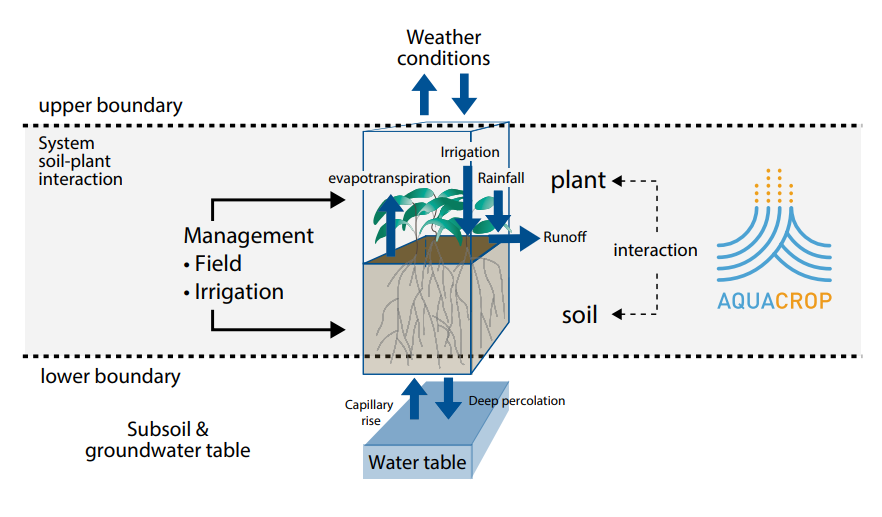
Figure 1: Aquacrop is a classical model used for agricultural applications. Based on various data, it can be used to calculate the interaction between the water table, soil and atmosphere at the scale of a plot. Figure from Salman et al. (2021). The AquaCrop model – Enhancing crop water productivity. Ten years of development, dissemination and implementation 2009-2019. FAO Water Report No. 47. Rome, FAO.
Construction (materials, technical sheet / cross-sections)
A model must always be tailored somewhat to the question and the measures to be calculated. Often existing models can be used to calculate the impact. These models will always model different aspects of the water system: the runoff of precipitation (hydrology), the watercourse (hydraulics), the sewer system… These models must be combined with standard time series of precipitation and evaporation must be calculated, so that (depending on the model) flow rates, water levels and groundwater levels can be obtained. In this way, measures can be scaled up locally. In addition, it is possible to model both current and future climate, allowing the impact of climate change to be investigated. For example, data on the climate portal (klimaat.vmm.be) have been calculated. Possible models include Aquacrop (focus on agricultural plots), PDM (focus on hydrology), Sirio (focus on hydrology and water use), among many others.
Maintenance
Setting up a model is not easy. It is important to check that all assumptions are correct, that everything is programmed correctly, and that the results are logical given the model. Some models are a priori suitable for modeling floods rather than droughts, and this must be taken into account. When all this is examined as a function of climate change, the assumptions associated with these climate data must also be checked.
Indicative prices for construction and other costs
There are roughly two main costs to conduct a modeling study: personnel costs on the one hand, and software costs on the other. Personnel cost is by far the largest cost. After all, scaling up and analyzing the results mainly involves programming, processing the results and summarizing them. There may also be additional software costs. After all, some specialized software costs money, although several tools are also freely available.
Economic benefits
By scaling up and gaining sufficient insight into the long-term consequences of the measure, in combination with other measures, under the influence of climate change, etc., an estimate can be made, both economically and in terms of biodiversity and ecosystem services, of the solution that is most profitable. This will often involve making trade-offs: there is rarely a silver bullet that provides a solution for everything. By using models, however, the possible solutions can be identified and compared.
Our partners






