
Project Updates
PTS Mechelen inaugurates underground storage of 600,00 liters of water
 Glastuinbouw
 Openlucht
 Verhogen van hemelwatergebruik
 Waterbesparing

Water is essential on any horticultural farm. Both water shortages and flooding have a major impact on crops and operations. This is no different for PTS Mechelen. As a well-known provincial school, they are giving the horticulturists of the future the tools they need to handle water smartly. For the first time in 2025, they used the roof surface of their greenhouses and buildings to collect excess rainwater. They store this water in brand-new underground tanks with a capacity of 600,000 litres. The investment – good for 500,000 euros – was fully supported by the Province of Antwerp, which is thus resolutely committed to sustainable and climate-robust education. To underpin the intervention technically, the school had a climate audit carried out by the Experimental Station for Vegetable Production, a partner in the European Life ACLIMA project. The advice was compiled into a Water Passport, which was used to tailor the installation to the site’s needs as much as possible.
Additional water buffer thanks to climate adaptation project
“With the installation of water tanks at PTS Mechelen, we are arming ourselves against the effects of climate change,” explained Luk Lemmens, responsible for Provincial Education Antwerp. “Thanks to the placement of these water recovery tanks, we are already teaching our students the importance of sustainable water management. This forward-looking policy not only benefits the school, but it also creates a climate-conscious generation of students. The installation of these water tanks demonstrates our commitment to sustainability, a key tenet of our provincial climate plan “Plan Today. This investment in water recovery is an example of how we are thinking ahead and preparing our schools for the challenges of the future,” added Deputy Lemmens.
Captured rainwater can bridge 2 months of drought
The 6 giant water tanks at PTS Mechelen are the final piece of an ambitious new construction project focused on sustainability. The 6 tanks, each with a diameter of 3 meters and a length of 15 meters, can collect 630 m³ of rainwater and together weigh 22.5 tons. From spring 2025, PTS Mechelen will be able to take full advantage of this rainwater recovery.
The new water tanks have been integrated into the recently opened sustainable new construction project on the campus, the so-called ‘Groentjesgebouw’. This new building was designed with attention to low energy consumption and an airtight, insulating outer shell. Water use on the site was also thoroughly rethought. The rainwater collected, with a capacity of 630 m³, is now used in the greenhouses, for watering plants, outdoor taps and flushing toilets. Thanks to this installation, the school can bridge a dry period of two months without using tap water or groundwater. This completely phases out the existing groundwater extraction at the site.
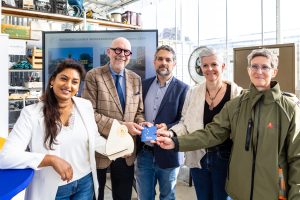
Presentation of Water Passport to PTS Mechelen – from left to right deputies Jinnih Beels and Luk Lemmens, project coordinator Joris De Nies of Life ACLIMA, director Kim Vervenne and technical director Kathleen Massant of PTS Mechelen – Copyright: provincie Antwerpen
Technical optimization support
For the technical fine-tuning of the system, the school called on the Experimental Station for Vegetable Production in Sint-Katelijne-Waver. This organization is part of the European Life ACLIMA project, which offers climate-robust solutions to agricultural and horticultural companies as well as schools. The testing station carried out a climate audit at the request of PTS Mechelen, which resulted in a personalized Water Passport. This included mapping out the benefits of buffering and reusing rainwater.
“Thanks to projects like Life ACLIMA, companies and schools can count on tailored advice after a thorough water audit,” said Deputy Jinnih Beels, responsible for Agriculture. “PTS Mechelen shows how you can also effectively convert that advice into sustainable practical applications. At the same time, we see that this model also works for individual agricultural and horticultural companies: in the coming months, 52 participants will receive their personal Water Passport. This offers them a clear overview of possible measures as well as a push to get started effectively. In this way we are building together, step by step, a climate-smart agricultural sector.”

“The Water Passport offers a customized overview: from small interventions to larger investments that pay off over time,” explains Joris De Nies, Life ACLIMA project coordinator. “PTS Mechelen was one of the first schools to use this tool and immediately put this advice into practice. This creates a great example of how knowledge and policy reinforce each other.”
Gerelateerde acties

Hergebruik van restwaterstromen en reductie van spuistroom in de glastuinbouw
Door gepaste behandelingsmethoden kunnen restwaterstromen terug nuttig ingezet worden in serreteelten en/of vollegrondsgroenten.
Glastuinbouw
 Externe waterbronnen
Waterbesparing
 Waterhergebruik

Infiltratie via klimaatadaptieve en peilgestuurde drainages
In deze actie demonstreren we de voordelen van klimaatadaptieve drainage op vijf tuinbouwpercelen in vollegrond.
Openlucht
Externe waterbronnen
 Inzetten op waterinfiltratie
Verhogen van hemelwatergebruik
Waterbesparing
Waterhergebruik

Voldoende opslag voor het hergebruik van het eerste drainwater
Drainwater aangelengd met regenwater, kan terug hergebruikt worden in het teeltseizoen mits voldoende opslagcapaciteit.
Glastuinbouw
Verhogen van hemelwatergebruik
Waterbesparing
Waterhergebruik

Circulair gebruik van spoel- en reinigingswater in pluimveestallen.
Door spoel- en reinigingswater te zuiveren, kan dit later opnieuw gebruikt worden voor het reinigen van pluimveestallen.
 Pluimvee
Waterbesparing
Waterhergebruik

Minder hittestress bij melkvee door klimaatsturing en ventilatie
Tijdens heel warme dagen willen we de hittestress die dieren ondervinden, beperken door verkoelende maatregelen toe te passen in rundveestallen.
 Melkvee
Waterbesparing
