
Rietveld
Why?
A dairy farm produces both domestic wastewater and farm wastewater. The farm wastewater includes rinse water from cleaning and disinfection of milking equipment, barns (and calf pens).
Agricultural farms are often located in areas without sewers or in areas where the sewers are not connected to a large-scale treatment plant. In these areas, the farmer himself is responsible for treating wastewater, unless the municipality takes the initiative.
Different rules apply to the discharge of domestic wastewater than to the discharge of industrial wastewater. When domestic wastewater is discharged together with company wastewater, the whole is considered company wastewater.
Contact person
Stefanie Verherstraeten (Hooibeekhoeve)
What
How
Cost
Benefits
Attention
Description & visualization of technique
The pollutant load coming from a dairy farm consists mainly of biodegradable components. A system of biological treatment can therefore be used to treat this fraction.
Active sludge system
In an activated sludge system, bacteria attached to the activated sludge provide purification. Conversions occur in several stages. In a first stage, lots of oxygen is added and oxygen-loving bacteria start breaking down nitrogen and carbon compounds. Then, in a low-oxygen phase, nitrate is converted to nitrogen gas, which is released into the air. All other minerals and phosphates are largely left behind in the sludge. There are many variants based on this treatment system. In a plant system such as a leachate reed bed and an aerated reed bed, the microorganisms are trapped on the plant roots and substrate of the reed bed and an oxygen-rich and -poor phase is also created.
leachate field: (source: waterway guide brochure for livestock farmers)
In a percolation reed field, after a preliminary sedimentation, the wastewater flows over a filter bed planted with reeds. There it infiltrates vertically and flows away through a drainage pipe at the bottom of the filter bed. For optimal purification, this irrigation is done intermittently. This can be achieved by 2 fields irrigated alternately or one field with a time-controlled pump operating intermittently. The intermittent irrigation ensures alternating aerobic and anaerobic conditions and therefore good nutrient removal.
Purification relies on the filtering action of the sand and on the action of soil bacteria and other microorganisms. The plants themselves provide additional purification. The seeping water sucks in air, so the system does not depend solely on the plants for the supply of oxygen. In general, the leachate field guarantees a higher purification efficiency than other plant systems because the soil acts as a filter.
The filter material used should have a uniform grain distribution. The finer the filter, the better the purification, but the greater the chance of clogging. After several years, the permeability of the filter will decrease. However, if the leachate reed field is properly sized, the reed will keep it open and aerated even in the long term due to its highly branched and coarse rhizomes.
Obviously, fewer problems will occur if gravel or pebbles are used, but these do not give a sufficiently long retention time and are therefore more suitable as pre-purification (filtering).
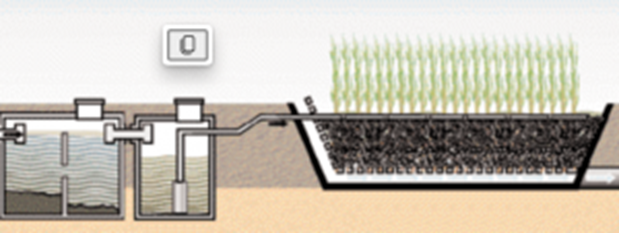
(Principle drawing of a leachate field) Source: VMM – brochure waterway guide for livestock farmers
Aerated reed field (reed field Hooibeekhoeve)
The aerated reed bed uses gravel or Argex granules as substrate in the filter bed. A characteristic feature is the network of aeration pipes at the bottom of the reed bed. Through these pipes, the reed bed is supplied with additional air from below. This makes it possible to efficiently treat a larger quantity or more heavily polluted wastewater on a smaller surface area.
Pre-purification
Thanks to a pre-settling well, coarser and settling particles are removed. This ensures that no solid particles are pumped onto the filter bed and clogging is prevented.
In order to purify rinse water from a milking plant, a good mechanical pre-purification stage such as a grease collection system and sand filter is also very important. This is because rinse water has a high fat content coming from the milk and fat is difficult to biodegrade. Therefore, fat must be mechanically captured.
Aftertreatment
The discharge standards for industrial wastewater are strict and it is not obvious to meet these standards with only biological treatment. Especially the standard for phosphate is a challenge here. In most systems, the biological step is followed by post-treatment with a substrate that binds phosphates, such as apatite or torbermorite. Proper phosphate removal must be followed up, however, because the substrate can become saturated.
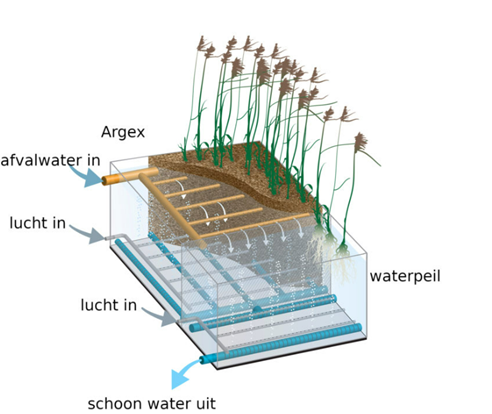
Aerated reed field source: reedland
Prior to the main treatment in the reed bed, a preliminary treatment takes place in a septic tank and/or grease trap. This first stage ensures that no solids are pumped along on the filter. This prevents clogging of the filter or irrigation lines.
The actual purification takes place in the reed bed. A reed bed or helophyte filter purifies water based on the action of bacteria located in the filter substrate made of gravel or Argex, as films on the grains and on the roots of the reed plants. Many of the wastes found in your wastewater are taken up by the bacteria as food and converted to water and carbon dioxide (carbonic acid gas). The bacteria need oxygen to do this. The function of the reed plants is to transport oxygen to the soil so that the bacteria can do their purifying work better. Furthermore, the plants serve as frost protection and the reed plants also ensure that the filter sand does not clog up. The effect of reed plants as oxygen providers continues even in winter. The above-ground plant parts die off, but the roots remain alive even then. Therefore, a reed bed works practically as well in winter as in summer.
Because the proper operation of the reed bed is strongly related to the amount of oxygen added, in an FBA type reed bed, additional air is pumped into the filter from below. This air is supplied through an air blower placed next to the filter or in the control box. The supplied air is distributed evenly over the entire surface via a system of manifolds in the bottom of the reed bed.
Construction (materials, technical sheet / cross-sections)
Are you considering purchasing a water treatment system? Then it is important to first map out the water flows and volumes. Be sure to take peak load into account. What volumes of treated water can be reused? And what volume do you effectively want to discharge? After all, every treatment system has a treatment efficiency. A purification efficiency of 99% is considered a well-functioning system. The higher the pollution load of the influent (dirty incoming water), the higher the pollution load is in the 1% residual fraction. Thus, the lower the dirt load of the influent is, the higher the probability of an acceptable effluent (treated water).
For example, do you also want to send the rinse water from your milking system (robot or classic) to your water treatment plant? Then remember that this contains a lot of fat and protein. Pure milk or the first rinse water with high milk concentrations has a very high dirt load for easy purification. Therefore, these fractions are often better directed into the manure pit. The rest of the rinse water, however, can be further purified. Thus an optimal purification efficiency is obtained.
To get an idea of your dirt load, it is interesting to have a water analysis done.
The options are extensive, a water treatment system is quite an investment and there are ongoing maintenance costs. So get guidance and look for the right partner to come up with an appropriate system tailored to your business.
Indicative prices for construction and other costs
Target price Reed Field Hooibeekhoeve: €90,000 but also other cheaper systems, firms, …
Relevant subsidy channels
For investments that contribute to increased farm resilience and more efficient water use, the Flemish Government provides VLIF investment support.
More info and conditions about VLIF-support on efficient water use can be found on the website of the Flemish Government – Department of Agriculture & Fisheries(https://lv.vlaanderen.be/nl/subsidies/vlif-steun/vlif-investeringssteun-voor-land-en-tuinbouwers).
For example, aid rates are provided for water reservoir/basin for rainwater harvesting and for water treatment/water purification. These can be found in the eligible investment list(https://lv.vlaanderen.be/sites/default/files/attachments/subsidiabele_investeringslijst_1.pdf)
Ecological benefits
The farm wastewater includes the rinse water from the milking plants which, according to previous calculations, comprises up to 20% of the total water demand at the farm level (of Hooibeekhoeve). Purified farm wastewater, after treatment, can be reused for cleaning barns, machinery and equipment. Water consumption for cleaning agricultural machinery is estimated at Hooibeekhoeve at 90 m³ per year. For the cleaning of boots, 125 m³ of water was used at Hooibeekhoeve in 2024 (this includes the cleaning of boots of visitors and of students for practical lessons, so this consumption may be higher than at another dairy farm). The reuse of treated wastewater can significantly reduce the consumption of mains water or pumped groundwater.
Relevant legislation, permits
On commissioning:
Weeds:
In the beginning when the reed has not yet covered the entire area of the reed bed, weeds may start to grow in the gravel layer. Especially during the first six months, these weeds will have to be weeded. Once the reed covers the entire filter, weed growth no longer occurs.
Young plants:
Especially immediately after planting and in the spring when young shoots are forming, reed is susceptible to trampling. It is therefore best to enter the reed bed as little as possible during these periods.
Furthermore, it is important to ensure that wild animals, such as rabbits and deer, do not have access to the reed bed. If the filter is constructed in an area where wildlife is abundant, it is advisable to protect the reed bed from eating by means of a buried fence.
Frost protection:
Reed beds established in the spring generally vegetate enough to completely cover the filter as early as the first year. In the fall, the aboveground parts of the reed plants wither and form an insulating blanket on the reed bed. This insulating blanket ensures that the reed bed will not freeze in the winter.
Reed beds laid out in the fall are often insufficiently overgrown, so that the insulation provided by the plants is then often insufficient. In this case, it is advisable to cover the reed bed with straw before winter. The straw is then protected from being blown away by a net. The straw is then removed again in the following spring. In general, this additional protection is only needed for the first winter. After that, the dead reeds take over the insulating function.
Our partners






