
Wadis & Infiltration Zone
Why?
Water that ends up on pavements or buildings is still too often accelerated towards the sewer system or streams and does not get the chance to infiltrate towards the groundwater.
By first allowing water to flow off towards a WADI (Water Drainage and Infiltration) we can slow down the flow. That way we limit overflows and can reduce flooding. This also ensures that water is not unnecessarily discharged to the sewage treatment plant. In a WADI or infiltration zone that water can temporarily in a WADI or infiltration zone. In this way, the water is in contact with the soil longer and has a chance to infiltrate towards the groundwater. In this way, we can replenish the groundwater more and limit our drought susceptibility.
What
How
Cost
Benefits
Attention
Description & visualization of technique
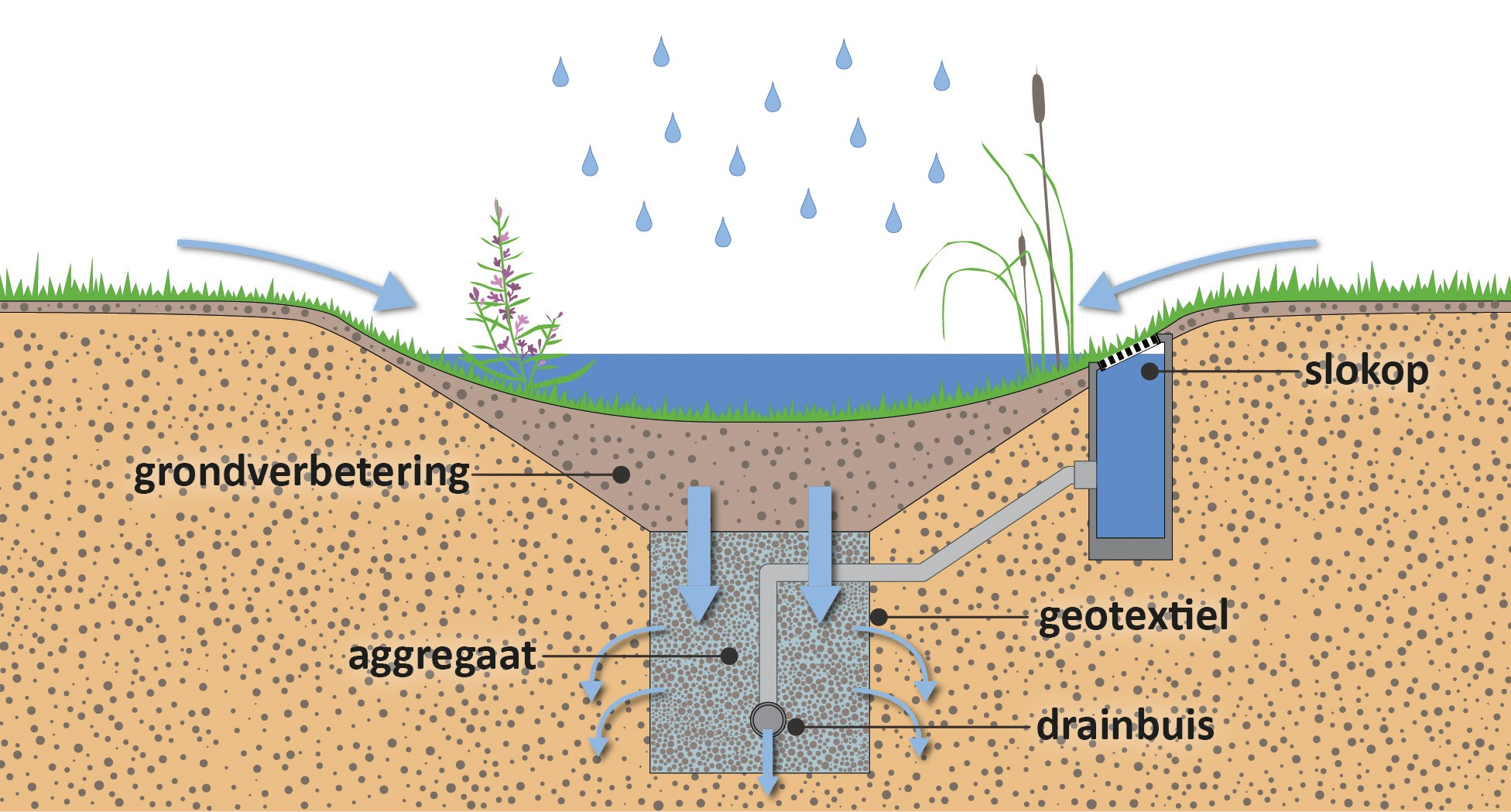
A WADI can temporarily store rainwater in a lower area. That water can then slowly infiltrate into the soil. The soil forms a kind of natural filter; in other words, the water enters the groundwater (partially) purified after its passage.
From top to bottom, the lower zone is composed of a planted top layer on a permeable soil. Under that top layer, a drainage layer is filled with permeable material (gravel, clay pellets). Geotextile prevents the drainage layer infiltration from silting up. The water that enters the coffer can thus flow easily towards an infiltration/drainage pipe.
To prevent flooding, the WADI can be equipped with an overflow. This will still allow water to drain more quickly to a drainpipe, a nearby stream, or stormwater runoff during high water levels.

Construction (materials, technical sheet / cross-sections)
Look here for different types of wadi and where they make sense.
https://gidsduurzamegebouwen.brussels/wadis/soorten-wadis
Landscape integration
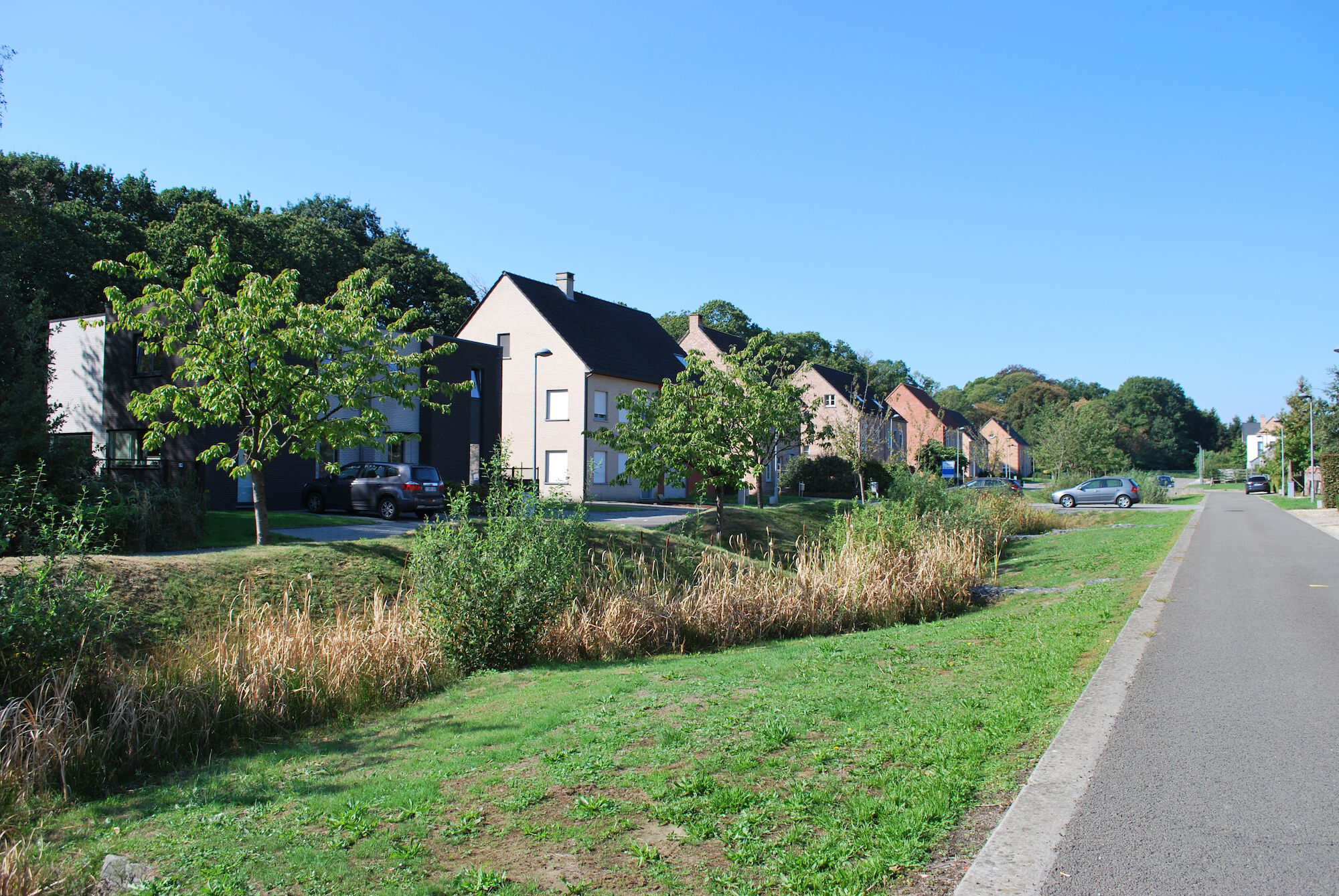
By default, a grass mixture is chosen. However, the maintenance of these grass strips is not evident given the slope and the moist surface. It may be more scenically attractive to make the wadi more nature-friendly. Not only grass or moisture-loving plants, but also small shrubs (e.g. willow, black alder) can be useful for biodiversity and stability. All management should be tailored to the type of vegetation in and around the WADI. It should also be inspected with sufficient frequency for (invasive) exotics such as Japanese knotweed, pale cypergrass, water crassula, etc. This way you can reduce maintenance costs and increase biodiversity. The presence of moisture-loving plants can improve the rooting of the soil, this benefits the infiltration capacity.
Look here for the guide to choice plantings.
How to make a nature-friendly wadi?
Maintenance
It is important to properly maintain a WADI to ensure its operation. It is best to remove leaf litter and litter several times a year. You should also regularly check that the drain is still working properly. If the drainage would silt up, you can spray it clean.
Grass-seeded WADIs require regular mowing, while a natural WADI requires less regular maintenance. With the latter, however, you should be mindful and check for litter.
Indicative prices for construction and other costs
Guide prices construction and other costs can be found here.
Relevant subsidy channels
Through the VLIF Non-Productive Investment Support (NPI), the investment in a WADI can be 100% subsidized. Subsidies are granted up to a cost price of 110€/m² (excluding VAT). More info can be found here.
These subsidies only apply to agricultural plots or company infrastructures, not to private applications.
Our partners






