
Weirs
Why?
One possible solution to both the shortage of water and the flooding caused by excessive precipitation is the weir. This is an engineering structure that allows water to be buffered in water-carrying field ditches. By stopping water from draining directly, it is given more time to infiltrate, making more water available to crops. In addition, they keep excessive precipitation from immediately flowing away through the ditch and also reduce downstream flooding by buffering.
Useful links
Agricultural reservoir managementWhat
How
Cost
Benefits
Attention
Description & visualization of technique
By placing a weir in an aquifer field ditch, the permanent draining effect of the ditch is stopped. This gives the retained water time to infiltrate, increasing the water table in the surrounding fields. This reduces the need for crops to root deeply for water, which has a beneficial effect during droughts. In a weir there are several removable stop logs, by sliding more or less removable stop logsinto the weir you determine the buffering height of the weir. This allows you to take out one or more bulkheads a few days before the start of field operations, so that the water table in the surrounding fields drops again (Figure 1). This allows machines to be driven in the fields. As soon as the field operations are over, the partitions can be put back in place and the water table can rise again (Figure 2).
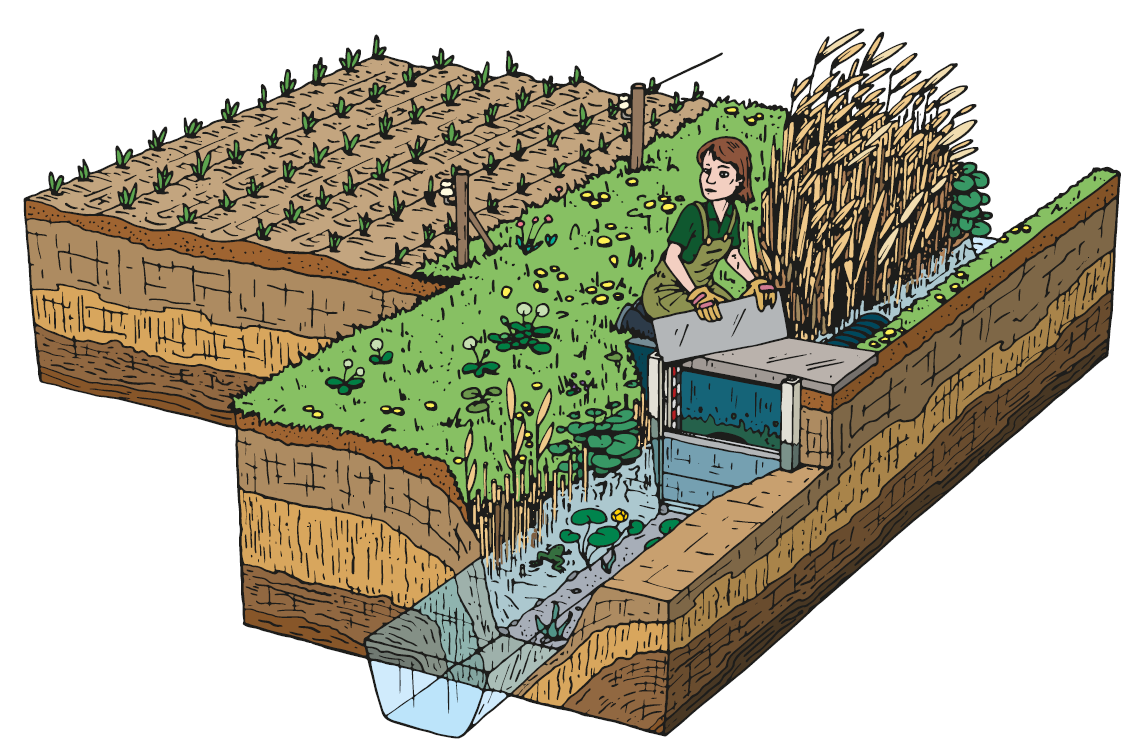
Figure 1 © Farmers Nature Flanders
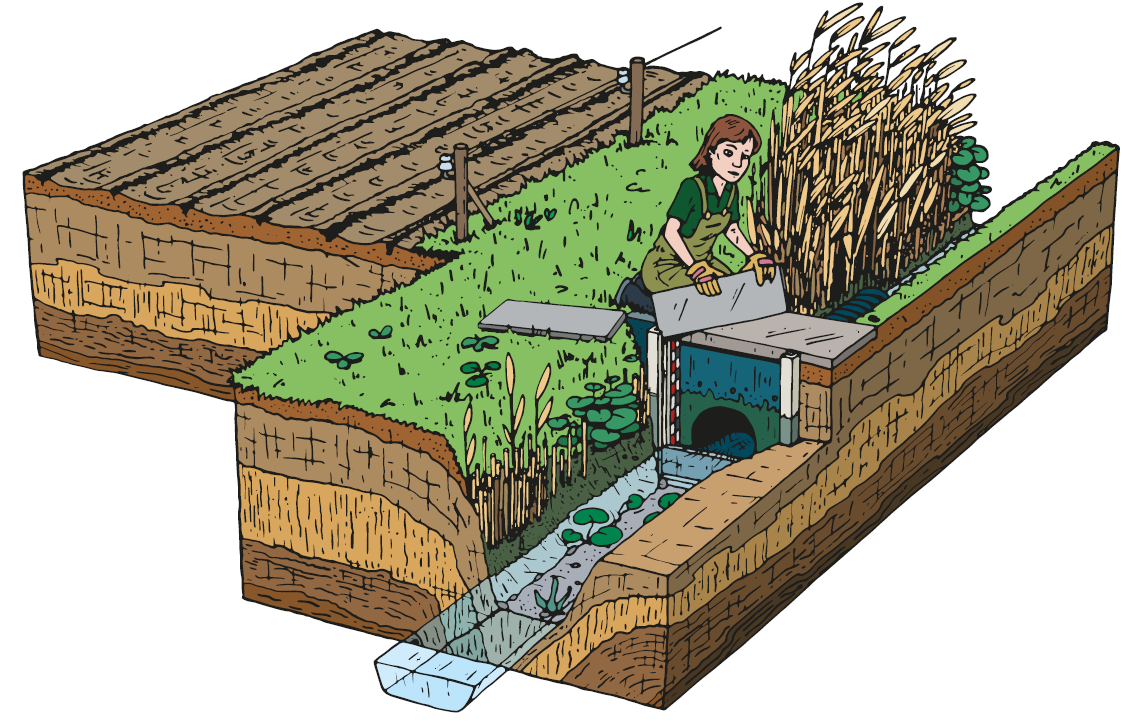
Figure 2 © Farmers Nature Flanders
In addition to normal removable stop logs, there are also removable stop logs with a pinch (a triangular opening), which is then called a pinch weir. The pinch allows delayed discharge. Below the pinch the water is conserved, between the pinch and the top removable stop logs the water is retained (delayed discharge), and above the top removable stop logs there is then overflow. A pinch is very practical, given that the buffer function of the weir is eliminated once the canal upstream is full. Thanks to the delayed discharge of the pinch, the buffer function of the moat is automatically restored after heavy rainfall. Moreover, it still ensures that peak flows in the downstream are avoided
Construction (materials, technical sheet / cross-sections)
Installing a weir is not technically difficult; however, an excavator is required for placement.
In addition, it is recommended that you ask for different types of bulkhead bars (of 5, 10 and 20 cm) when you purchase and make sure you have more bulkhead bars than you can fit in the weir. This will allow sufficient variation in weir height as needed. Also make sure there is a bulkhead with pinch (triangle of 10 by 10 by 10 cm). In addition, it is also good to ask for several bulkhead bars with rubber seal (the bottom bulkhead bar has a rubber seal so that the weir is watertight): e.g. one with and one without orifice.
It is appropriate to adequately stabilize the weir with sheet piles (transverse) and a sewer pipe (extended). If the weir is attached to a sewer pipe from a culvert or over-well, it is important to slide the sewer pipe at the weir over, and not into, the outflow structure. This avoids leaching (which is difficult to determine).
Location:
Weirs can only be placed in parcel canals and are in principle forbidden in category 1, 2 and 3 watercourses (because there are directives in force which prohibit fish migration bottlenecks). If you do consider installing a weir in such a watercourse, contact the watercourse manager or Boerennatuur Vlaanderen. In exceptional cases it may be allowed.
The flatter the landscape, the larger the area that will experience a beneficial effect from the weir.
Landscape integration
The landscape impact of a weir is very limited. You can see it in the moat, but it does not rise above ground level, or very little. The presence of water in the moat increases the added landscape value.
Maintenance
Managing a weir is simple. As mentioned earlier, the level can be determined via the weir’s removable stop logs. A few days before field operations (in spring and fall), one or more removable stop logs can be removed from the weir to lower the water level. As soon as the field operations have taken place, the partitions can be replaced. The shorter the drainage period, the better the results will be.
Ideally, the weir should remain closed in the fall and winter (all bulkheads in) in order to conserve water for dry periods in the growing season. When desirable, a removable stop logs with a pinch can also be placed in the weir (e.g., when high or abundant precipitation is expected, and delayed discharge is best).
Furthermore, buffering may also benefit from occasional flushing of the weir. Due to sedimentation upstream of the weir, stream bottom elevation can occur, which in turn leads to reduced buffering capacity of the ditch. Herb growth in the creek can also cause reduced buffering capacity, so mowing with runoff is recommended when there is a lot of herb growth. However, water at a well buffering weir will just suppress herb growth.
Indicative prices for construction and other costs
The cost of a weir is about €4,700, including installation.
Relevant subsidy channels
Via the VLIF non-productive investments (NPI) support, weirs are 100% reimbursable (excluding VAT) up to a maximum amount of € 3000 per weir.
There are also regular water conservation projects in Flanders, in which weirs are placed as a measure. The project then also offers guidance in the placement of the weir(s).
Economic benefits
The economic gain is difficult to quantify, as it depends on many external factors (soil type, slope, weather conditions, crop type,…). Obviously, the main purpose of the weir is to avoid drought damage to crops on surrounding fields.
The distance to where the water level in the soil increases around a weir is between 15 and 100 meters along both sides of the ditch, depending on the soil type and soil profile. The length along which this effect occurs in turn depends on the slope of the moat. Depending on the width, depth and length of the trench, the usual volume that can be buffered is about 156m³ per 100 running meters (for an average trench of 1.25 m x 1.25 m diameter). However, this volume can easily reach 500m³ of buffered water, depending on the canal profile.
Ecosystem services, biodiversity
The main advantage, of course, is the water conservation: water is retained in plots.
Due to its buffering effect, peak flows are reduced. This also reduces downstream flooding.
Relevant legislation, permits
An environmental permit is required for the installation of weirs, you can apply for it at the municipality
Sources for information & guidance
Work with your neighbors! When you hold up water via the weir, the surrounding soil will also become wetter. When you drain the water, the surrounding landscape will also become drier. Therefore, coordinate with your neighbors to drain as briefly as possible, which will yield the best results.
The effect of one weir is already visible on a microscale, but of course multiple weirs in the area create a reinforcing effect on a broader scale. This is why it is interesting to place several weirs in an area together with other farmers in the neighborhood. With good mutual coordination, you can thus achieve maximum results!
Avoid damage: place a post near your weir and mark it clearly. Also, be sure to notify your contractor that the weir is there.
Our partners








